
Politics
‘There Would Have Been No CJP’: Abhijeet Dipke Credits CJI Surya Kant for Sparking Student Movement, Says ‘Thank You for Waking Us Up’
Cockroach Janta Party founder Abhijeet Dipke says remarks attributed to Chief Justice of India Surya Kant inspired him to return to India and launch a nationwide student-led movement over the NEET-UG controversy.

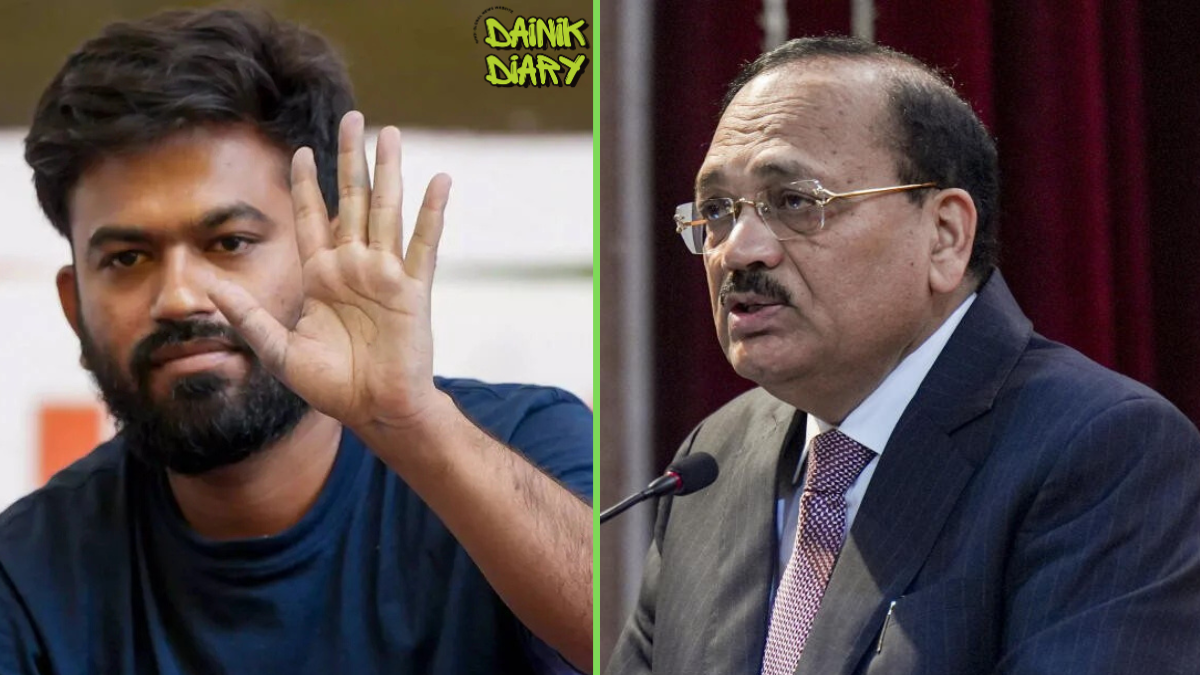
Cockroach Janta Party (CJP) founder Abhijeet Dipke has credited Chief Justice of India (CJI) Surya Kant with unintentionally inspiring the nationwide student movement that emerged after the NEET-UG 2026 controversy.
In an interview with independent media platform Peek TV, Dipke said the remarks attributed to the Chief Justice prompted him to return from the United States and launch what later became the CJP-led campaign against alleged examination irregularities.
‘The Real Credit Goes to Him,’ Says Dipke
Speaking about the origins of the movement, Dipke said the phrase that led to the formation of the Cockroach Janta Party ultimately became a rallying point for thousands of students across the country.“The real credit goes to him. Had he not used the word cockroach, I wouldn’t have come back to India. There would have been no CJP, there would have been no hunger strike by Mr Sonam Wangchuk. There wouldn’t have been thousands and lakhs of people on the streets across India,” Dipke said.
When asked whether he agreed with those who jokingly describe CJI Surya Kant as the “founder” of the CJP, Dipke responded that he did.
He also added:“I would like to thank the Chief Justice of India. Thank you, sir, for calling us cockroaches, and thank you for waking us up.”
Background to the Controversy
The controversy began during a Supreme Court hearing in May, when a Bench comprising CJI Surya Kant and Justice Joymalya Bagchi was hearing a petition related to the implementation of guidelines on the designation of senior advocates.
During the proceedings, the Chief Justice criticised what he described as increasing attacks on the judiciary and legal institutions.
He remarked that some unemployed youngsters become activists or social media commentators and referred to such individuals as “cockroaches” and “parasites of society.”
The remarks quickly went viral on social media.
However, CJI Surya Kant later clarified that his comments were directed at individuals entering the legal profession using fake and bogus degrees and that his observations had been misquoted and taken out of context.
ALSO READ : ‘PM Enjoys Playing the Victim Card’: Jairam Ramesh Demands Modi’s Apology Over NEET, Ram Mandir Trust Row and Demonetisation
How the CJP Was Formed
Soon after the controversy, Dipke announced the formation of the Cockroach Janta Party (CJP).
What initially began as a symbolic protest soon evolved into a broader youth-led campaign highlighting concerns over alleged irregularities in competitive examinations, particularly NEET-UG 2026.
The movement later received nationwide attention, with environmentalist Sonam Wangchuk joining the campaign through an indefinite hunger strike that lasted 26 days before he was hospitalised.
Over the following weeks, protests spread across several states, drawing participation from students and support from various opposition parties.
Dipke Opposes Appointment of New Education Minister

Dipke also reiterated his criticism of the appointment of Pralhad Joshi as the new Union Education Minister following the resignation of Dharmendra Pradhan.
Speaking to ANI, he said the protesters’ demand for Pradhan’s resignation had been fulfilled, but expressed dissatisfaction with his successor.
He also claimed that the government’s promise to provide ₹1 crore compensation to the families of NEET aspirants who allegedly died by suicide has not yet been implemented.
Questioning the delay, Dipke alleged that the authorities were citing procedural rules instead of acting on the assurance given during discussions with the protesters.
Movement Remains Active
Although the CJP ended its protest after the government’s assurances and the resignation of the former Education Minister, Dipke has repeatedly stated that the organisation is prepared to resume demonstrations if its remaining demands are not fulfilled.
He has also maintained that the CJP will continue functioning as a people’s movement rather than entering electoral politics, arguing that its focus remains on student rights, examination reforms and public accountability.






Pingback: DK Shivakumar Expands Karnataka Cabinet… 20 Ministers Sworn In As Congress Fills Key Constitutional Posts - Dainik Diary - Authentic News
Pingback: Opposition To Corner Centre In Parliament: INDIA Bloc Demands Amit Shah's Statement On Student Protest Crackdown - Dainik Diary - Authentic News
Pingback: No FIRs Against Student Protesters, Government Assures Supreme Court; Cases Against 2,700 Others To Continue - Dainik Diary - Authentic News