
Politics
‘CEC Has No Right to Remain in Office’: Mallikarjun Kharge Targets Gyanesh Kumar, Lists 5 Election Commission Demands
Congress president Mallikarjun Kharge has intensified his party’s attack on Chief Election Commissioner Gyanesh Kumar, calling him a “puppet” of the Modi government and setting out five demands related to electoral rolls and transparency. The Election Commission, however, has rejected suggestions that reported internal differences mean its SIR decisions lacked consensus.


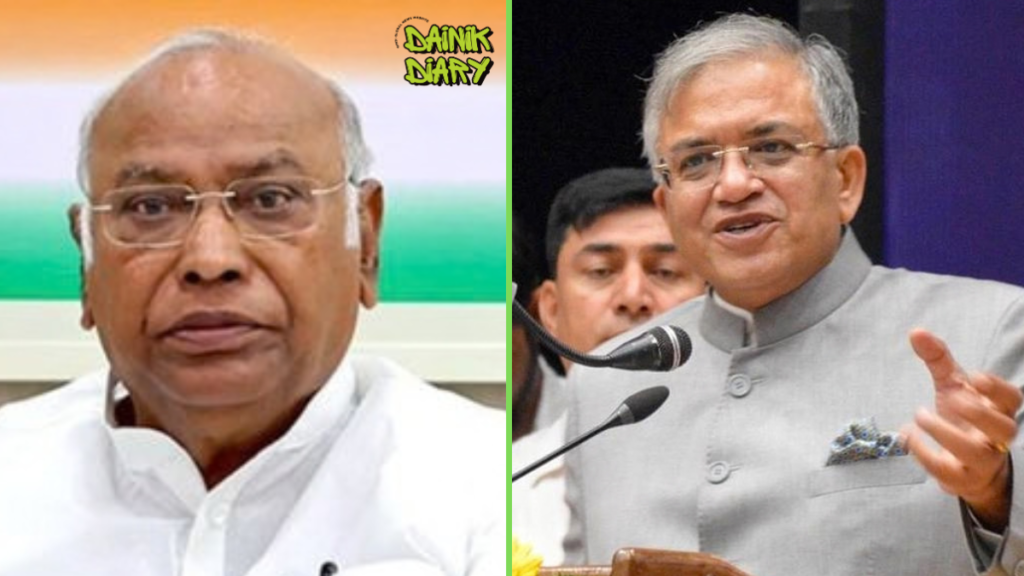
The political confrontation over the Election Commission of India (ECI) and the Special Intensive Revision (SIR) of electoral rolls has escalated further, with Congress president Mallikarjun Kharge directly targeting Chief Election Commissioner Gyanesh Kumar.
Addressing a Congress Working Committee (CWC) meeting on Tuesday, Kharge alleged that Kumar had become a “puppet” of the Narendra Modi government and said he had “no right to remain in office.”
The Congress chief also presented five demands that he said were necessary to protect voters’ rights and strengthen confidence in the electoral process.
His remarks follow an Indian Express investigation reporting that Election Commissioners Sukhbir Singh Sandhu and Vivek Joshi had formally raised objections on at least 14 occasions over 10 months concerning different electoral-roll and SIR-related matters.
The Election Commission has pushed back against the controversy, saying differences of opinion are part of institutional deliberations and maintaining that the relevant final decisions were taken unanimously.
What are Kharge’s five demands?
At the CWC meeting, Kharge laid out a five-point set of demands concerning electoral rolls and election administration.
He called for:
- Public disclosure of data concerning major additions, deletions and other changes to electoral rolls.
- Voters whose names are deleted to be properly informed and given an opportunity to appeal.
- Political parties to receive electoral-roll data in a simple and accessible format within a reasonable timeframe.
- Independent and time-bound investigations whenever serious discrepancies are identified.
- Greater transparency in election-related data and decisions so that information is not perceived as being withheld.
Kharge presented the demands as safeguards for voter rights and public confidence in elections.
‘CEC has become a puppet’: Kharge attacks Gyanesh Kumar
Kharge used particularly strong language while discussing the controversy.
He alleged that names were being removed from voter lists through a “conspiracy” and accused the CEC of acting as a “puppet” of the Modi government.
These are political allegations made by the Congress president; they have not been established as findings by a court or independent investigation.
Kharge argued that the CEC should leave office and also accused Prime Minister Narendra Modi of exerting pressure on the poll panel. He sought Modi’s resignation on what he described as moral grounds.
Why are ‘14 objections’ at the centre of the controversy?
The latest political confrontation follows an investigation by The Indian Express into internal correspondence at the Election Commission.
The report said Election Commissioners Sukhbir Singh Sandhu and Vivek Joshi had placed objections on record on at least 14 occasions over the preceding 10 months.
The reported disagreements concerned several important aspects of electoral-roll administration.
These included new voter registration and Form 6, deletion and restoration of names, appeals involving restored voters, and the custody and centralisation of electoral-roll data.
Kharge questions whether commissioners were kept out of decisions
Kharge cited the reported disagreements while questioning how the Election Commission had been functioning internally.
He raised questions over whether the two Election Commissioners had been excluded from an internal portal and whether some decisions had been taken without their full participation.
Kharge argued that the reported correspondence strengthened the Congress’s concerns about transparency within the institution.
However, the existence of objections during deliberations does not by itself establish that the Commission’s final decisions were unlawful or lacked the required institutional approval.
Election Commission gives a different account
The Election Commission has disputed the interpretation that the reported correspondence demonstrates an institutional breakdown.
Its response has been that internal differences are part of the normal deliberative process within a multi-member constitutional body.
The Commission has also maintained that the eventual decisions concerning the SIR were taken unanimously.
That creates an important distinction in the controversy: the Indian Express reporting documents objections raised during the decision-making process, while the ECI says the final decisions ultimately reflected agreement among the commissioners.
Who currently makes up the Election Commission?
The Election Commission currently has three members.
Gyanesh Kumar serves as the Chief Election Commissioner, while Sukhbir Singh Sandhu and Vivek Joshi serve as Election Commissioners.
According to the ECI, Kumar became India’s 26th Chief Election Commissioner on February 19, 2025. Joshi joined as Election Commissioner on the same date, while Sandhu has served as an Election Commissioner since March 2024.
Kharge backs Rahul Gandhi’s electoral-roll allegations
Kharge also reiterated support for Rahul Gandhi’s earlier claims about electoral-roll irregularities.
He referred to questions raised by Gandhi using voter data relating to Mahadevapura in Bengaluru, Aland in Karnataka, Haryana and Maharashtra.
Those allegations have been part of a broader Congress campaign challenging aspects of voter-list management and demanding greater transparency from the Election Commission.
The Election Commission and political opponents of the Congress have disputed several of the Opposition’s broader claims about electoral manipulation.
ALSO READ : PM Modi Birthday: From Gujarat CM to Prime Minister, How Much Has His Salary Increased? The Number May Surprise You…
Congress says fight is about voters, not an institution
Despite his sharp criticism of the CEC, Kharge sought to frame the Congress campaign as one aimed at protecting the credibility of elections rather than weakening the Election Commission as an institution.
“Our fight is not against any party, organisation, or individual, but to protect the rights of Indian voters, the Constitution, and India’s democratic system,” Kharge said.
The party says its objective is to ensure that voters can be confident that their names remain on electoral rolls and that election-related information is transparent.
SIR controversy is unlikely to end here
The dispute has now moved beyond questions about individual electoral-roll procedures.
It has become a wider political argument over how decisions are made inside the Election Commission, how voter-list changes should be communicated and how much electoral data should be publicly accessible.
The Election Commission’s position is that internal exchanges demonstrate deliberation and that its final SIR decisions were unanimous. Congress, meanwhile, argues that the reported objections raise questions serious enough to require greater disclosure and independent scrutiny.
With Kharge now putting forward five specific demands and directly seeking accountability from the CEC, the debate over SIR, voter rolls and Election Commission transparency is likely to remain a major political issue.

