Politics
Chirag Paswan questions ECI amid SIR row: From ‘purification’ ritual to reservation, times NDA ally took a different line
Union Minister and LJP (Ram Vilas) chief Chirag Paswan remains a BJP-led NDA ally, but his remarks on the Election Commission, caste discrimination, Bihar law and order and his party’s expansion plans show that he has repeatedly articulated positions distinct from the wider alliance narrative.


Chirag Paswan remains firmly within the BJP-led National Democratic Alliance (NDA), but that has not stopped the Union Minister from publicly raising uncomfortable questions — including on issues involving institutions, governments and political positions associated with his own allies.
His latest intervention has come amid the controversy surrounding the Election Commission of India (ECI) and Chief Election Commissioner Gyanesh Kumar.
Paswan stopped short of endorsing the Opposition’s political demands against the CEC. Instead, he focused on public confidence in the electoral process, saying that if questions were being raised about an independent constitutional institution, it was the Commission’s responsibility to explain its position clearly.
“If questions are being raised on Election Commission, which is an independent constitutional body, responsibility lies with CEC to present his stance clearly,” Paswan said on Friday.
He added that the Commission did not need to satisfy Rahul Gandhi or the Opposition, but it did need to ensure that doubts did not take root among ordinary voters.
“It is problematic if people begin to doubt electoral process itself. The EC needs to present its stance, not to Rahul Gandhi, but to public,” Paswan said.
The remarks are notable because they came from a serving Union Minister and NDA ally at a time when the Election Commission is facing intense political scrutiny.
Why is the Election Commission facing fresh questions?
Paswan’s remarks followed an investigation by The Indian Express concerning internal disagreements within the three-member Election Commission.
According to the report, Election Commissioners Sukhbir Singh Sandhu and Vivek Joshi recorded objections on at least 14 occasions over a 10-month period concerning various decisions and orders under CEC Gyanesh Kumar.
The reported disagreements involved electoral-roll procedures and administrative decisions, adding another layer to the political controversy surrounding the Special Intensive Revision (SIR) exercise.
Paswan’s intervention was carefully framed.
Rather than accepting the Opposition’s allegations as established fact, he argued that the Election Commission itself should answer questions strongly enough to maintain public confidence.
“The Election Commission must maintain the trust of the people because if doubts arise in the public’s mind about the electoral process itself, that would be wrong,” he said.
It is not the first time Paswan has publicly adopted a position that does not neatly mirror the political messaging of other NDA leaders.
Paswan raised alarm over incidents in Jamui and Samastipur
Just a day earlier, Paswan had spoken publicly about incidents in Jamui and Samastipur in Bihar, describing developments involving alleged anti-social elements as a serious concern.
He said such incidents needed to be treated with “utter seriousness” and revealed that he had spoken to Bihar Chief Minister Samrat Choudhary about the matter.
The intervention reinforced Paswan’s willingness to publicly flag law-and-order concerns even when governments involving his political allies could face questions over them.
That approach is politically significant for the LJP (Ram Vilas), whose support base and electoral identity remain closely linked to Bihar even as the party attempts to expand beyond the state.
Swatantra Bhardwaj controversy: Paswan went to police
Earlier in September, Paswan took an unusually direct step when his name surfaced in claims made by Swatantra Bhardwaj.
Paswan filed a police complaint after Bhardwaj allegedly invoked his name while claiming political connections and protection.
The Union Minister publicly distanced himself and the LJP (RV) from Bhardwaj, arguing that being photographed with or meeting someone did not automatically establish a personal or political relationship.
The episode allowed Paswan to draw a clear boundary around who could legitimately claim association with him or his party.
‘Purification’ controversy brought caste discrimination back into focus
Another significant intervention came in August following controversy over a reported “purification” ritual in Uttarakhand at a venue where Congress president Mallikarjun Kharge had addressed a rally.
Paswan raised concerns over the broader social message associated with such incidents, particularly in the context of discrimination against Dalits.
His response was notable because he framed caste discrimination not simply as an Opposition allegation, but as something governments also had a responsibility to confront.
“If the social situation remains unchanged, it is certainly a matter of concern for our government as well,” Paswan said.
For the leader of a party founded by Ram Vilas Paswan, questions involving Dalit representation and dignity carry particular political significance.
Paswan draws a firm line on reservation
Paswan has similarly taken an unequivocal public position on reservation.
Responding to political debate surrounding the issue, he stressed that reservation was protected constitutionally and could not simply be abolished because an individual or organisation demanded it.
His argument also directly acknowledged the political relationship among the RSS, BJP and LJP (RV) within the broader NDA ecosystem while maintaining his own position.
“After all, aren’t the Sangh, the BJP, and our party all part of the NDA? Is reservation something that can be abolished just because someone says so? It is a constitutional right,” Paswan said.
The message was consistent with the political identity he has sought to maintain: alliance politics on one side, but an independent voice on issues his party considers fundamental on the other.
ALSO READ : PM Modi Birthday: From Gujarat CM to Prime Minister, How Much Has His Salary Increased? The Number May Surprise You…
LJP (RV) has its eyes on all 403 UP seats
Paswan’s independent political ambitions are also visible outside Bihar.
In July, he said the Lok Janshakti Party (Ram Vilas) was preparing its organisation across all 403 Assembly constituencies in Uttar Pradesh ahead of the 2027 Assembly election.
Reports at the time quoted Paswan as saying that the party was preparing for all 403 seats. However, he also said it was too early to determine whether LJP (RV) would ultimately contest alone or through an alliance, making the distinction important.
More recently, reports have indicated that the party is looking at an NDA seat-sharing arrangement as it prepares for elections in Uttar Pradesh and Punjab.
The strategy nevertheless demonstrates Paswan’s desire to expand his party beyond its traditional Bihar base rather than depending entirely on seats allocated through existing alliance equations.
Ally, but with a distinct political identity
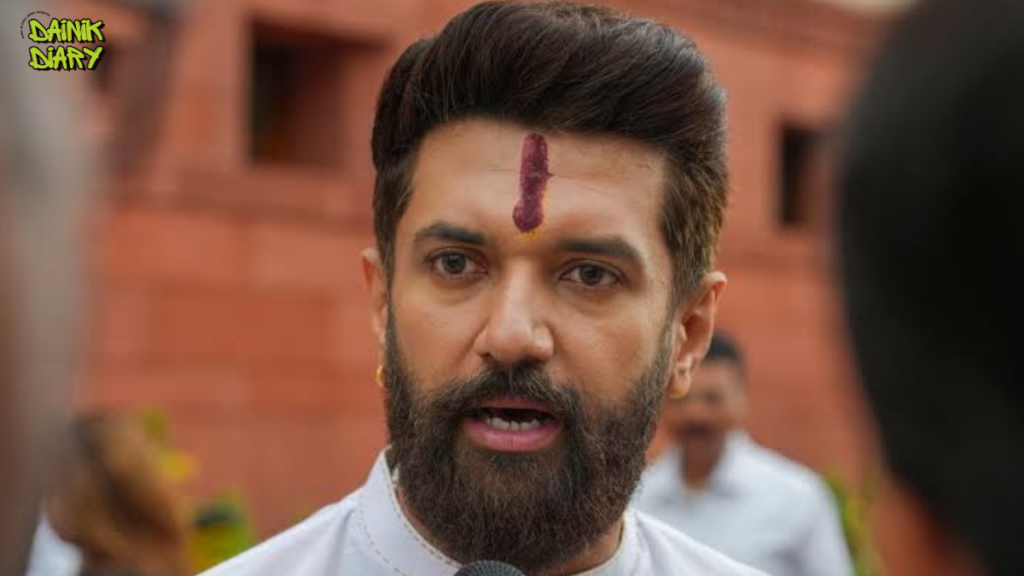
None of these positions necessarily amounts to a break with the NDA itself.
Paswan continues to serve in the Union government and his party remains part of the ruling coalition. His comments on the Election Commission, for example, did not endorse the Opposition’s demand for Gyanesh Kumar’s resignation; instead, he called for the constitutional body to answer public concerns clearly.
What the episodes do illustrate is a political strategy in which Chirag Paswan attempts to preserve a distinct LJP (RV) identity while remaining inside the NDA.
Whether the subject is SIR, public confidence in the Election Commission, caste discrimination, reservation, Bihar’s law and order or expansion into Uttar Pradesh, Paswan has repeatedly shown a willingness to articulate his own position rather than simply repeat the broader alliance line.
For an NDA partner seeking to expand nationally while retaining its traditional political base, that balancing act could become increasingly important as the next round of state elections approaches.