
Entertainment
Gandhari Movie Review: Taapsee Pannu Turns a Mother’s Worst Nightmare Into a Fierce Fight for Survival… But Does It Deliver?
Devashish Makhija’s dark revenge thriller blends motherhood, crime and raw action, with Taapsee Pannu carrying the emotional weight of a woman who refuses to stop until her missing daughter is found.

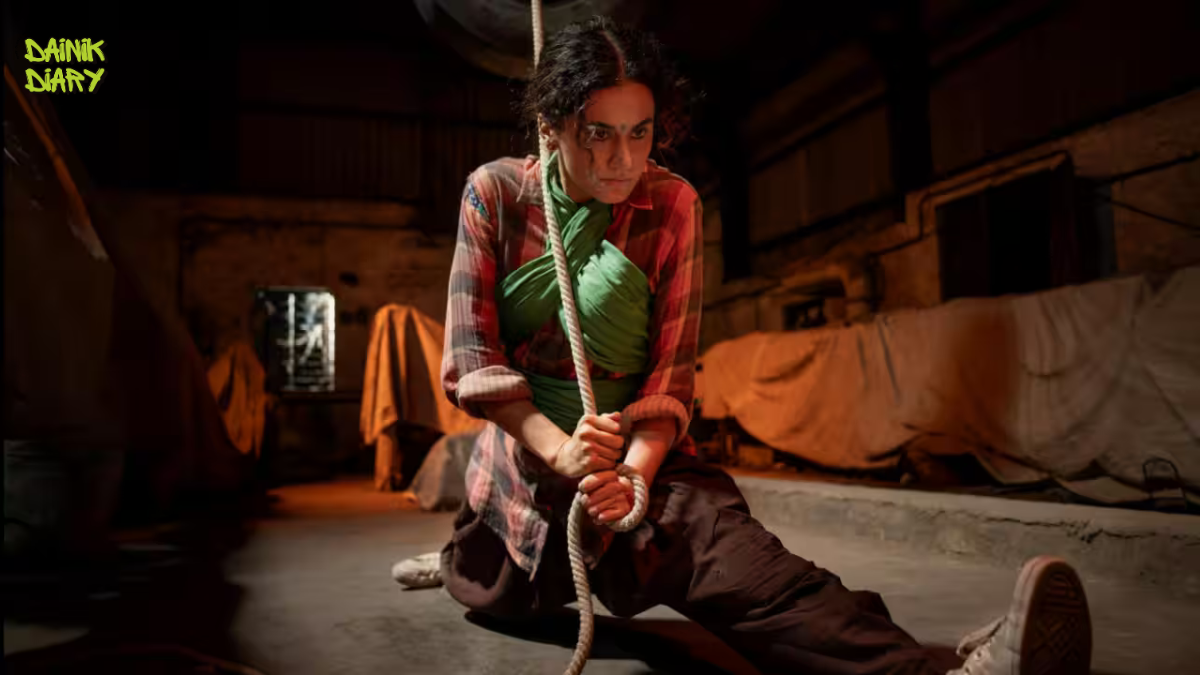
A mother searching for her missing child is an emotionally powerful premise on its own. Gandhari takes that fear and pushes it into darker territory, turning an ordinary woman’s desperation into a dangerous journey through crime, violence and buried secrets.
Directed by Devashish Makhija and written and produced by Kanika Dhillon, Gandhari stars Taapsee Pannu at the centre of a tense mother-daughter story. The film, which premieres on Netflix on September 3, combines emotional drama with suspense and grounded action rather than presenting its protagonist as a larger-than-life action hero.
And that approach becomes one of the film’s biggest strengths.
A Train Journey That Changes Everything
The story opens with Bani, played by Taapsee Pannu, travelling by train with her husband Gokul, portrayed by Ishwak Singh, and their young daughter Mishti, played by Myrah Shivan.
What begins as an ordinary family journey quickly turns into a nightmare when the train briefly stops at Joypurra, a small station in West Bengal.
Gokul steps out to get food while Bani takes Mishti towards the washroom. Within moments, however, Mishti disappears.
Bani frantically searches the train before spotting something horrifying through the window a woman running away with her daughter.
Her maternal instinct takes over.
Bani jumps from the train and gives chase, but the pursuit ends violently when she strikes her head against a heavy iron object and loses consciousness.
When she wakes up, Mishti is gone and Bani’s own condition has become far more complicated.
Bani Can Barely See, But She Refuses to Stop Searching
The head injury severely affects Bani’s eyesight, forcing doctors to advise her to keep her eyes covered.
For most people, that would make an already impossible search even more difficult. For Bani, however, giving up is never an option.
She begins following whatever clues she can find, gradually entering the unsettling world of Joypurra, where criminals, hidden motives and dangerous characters appear to stand between her and her daughter.
This is also where the title Gandhari gains significance.
In the Mahabharata, Gandhari famously blindfolded herself after marrying the blind king Dhritarashtra. Here, Bani’s covered eyes become part of the film’s own symbolism although her journey is driven not by her husband, but by the desperate need to find her child.
The central mystery continues to raise uncomfortable questions: Where is Mishti? Who took her? And what exactly is hiding beneath the surface of Joypurra?
Taapsee Pannu Is the Film’s Beating Heart
The film belongs overwhelmingly to Taapsee Pannu.
As Bani, she has to move between fear, helplessness, grief, anger and physical aggression without making the transformation feel completely detached from the woman introduced at the beginning.
She succeeds largely because the character’s emotional motivation remains clear.
Bani does not suddenly become fearless. She is terrified, injured and emotionally shattered but continues moving because her daughter matters more than her fear.
That distinction gives Taapsee’s performance considerable emotional force.
Her action scenes are deliberately rough rather than polished. There is pain, exhaustion and desperation in the way Bani fights, making the physical confrontations feel like extensions of her emotional state.
Some of Taapsee’s strongest moments, however, arrive away from the action. Her expressions communicate Bani’s panic and determination even when the screenplay gives her little dialogue.
Supporting Cast Gives Joypurra More Weight
Ishwak Singh delivers a controlled performance as Gokul, while Jatin Sarna leaves an impression as a police officer.
The presence of performers such as Chhaya Kadam, Swastika Mukherjee and Mita Vashisht further strengthens the film’s world, even when individual characters do not receive extensive screen time.
ALSO READ : ‘Perhaps Toxic Is Far Ahead of Its Time’: Sumalatha Backs Yash Amid Negative Buzz, Says ‘You Outshine Yourself in Every Frame…’
Young Myrah Shivan, as Mishti, also contributes effectively to the film’s emotional foundation.
Importantly, the supporting characters generally feel connected to the unfolding mystery instead of existing merely to move Bani from one action sequence to another.
Devashish Makhija Keeps the Action Dirty and Grounded
Director Devashish Makhija avoids turning Gandhari into a glossy revenge spectacle.
The violence is physical and uncomfortable. The locations feel lived-in, while the darker corners of Joypurra create a persistent sense that Bani is moving deeper into a world she does not fully understand.
That grounded treatment suits the story.
Instead of asking audiences to believe that Bani has suddenly transformed into an unstoppable action machine, the film repeatedly reminds viewers of her vulnerability.
Her emotional struggle remains as important as the physical danger surrounding her.
Kanika Dhillon’s Writing Keeps a Woman at the Centre
Writer Kanika Dhillon builds the screenplay firmly around Bani rather than allowing the criminal conspiracy to overwhelm her personal story.
The film introduces twists and revelations at regular intervals, gradually changing what viewers understand about Joypurra and some of the people inhabiting it.

There are stretches, particularly in the latter portion, where experienced thriller audiences may anticipate certain developments before the screenplay reveals them.
Still, the pace prevents these predictable moments from becoming fatal weaknesses.
At approximately 1 hour and 55 minutes, the film does not overstay its welcome. The editing keeps events moving, while the background score and sound design help intensify Bani’s fear and disorientation.
Gandhari Is More Than a Straightforward Revenge Thriller
Calling Gandhari simply an action film would miss what it is trying to achieve.
The guns, fights and criminal underworld provide the thriller framework, but the film’s emotional engine is motherhood.
Bani is fighting because something precious has been taken from her, and every obstacle forces her further beyond the limits of the person she once believed herself to be.
That gives the violence an emotional purpose.
The combination of Kanika Dhillon’s screenplay, Devashish Makhija’s grounded direction and Taapsee Pannu’s committed performance allows the film to remain engaging even when some of its twists become easier to predict.
Verdict
Gandhari works best when it stays close to Bani a frightened mother who has every reason to collapse but chooses to keep moving.
Taapsee Pannu brings vulnerability and fury together in one of the film’s strongest elements, while the supporting cast and atmospheric setting give the thriller a darker, more believable edge.
It may not reinvent the revenge-thriller genre, and some later developments are easier to see coming, but its emotional core gives the familiar structure greater weight.
For viewers who enjoy dark crime thrillers, motherhood-driven survival stories and grounded action with an emotional centre, Gandhari makes for an intense OTT watch.












Pingback: What Is Mahesh Babu Really Like On Sets? Insider Calls Him A ‘Stress Buster’ Reveals His Fun Side - Dainik Diary - Authentic News
Pingback: Irumudi OTT Release: Where Will Ravi Teja’s ₹200 Crore Blockbuster Stream Online? September Date Reportedly Under Discussion… - Dainik Diary - Authentic News