
Politics
“Student Movement Took Us by Surprise…”: Delhi BJP Unveils New Gen Z Strategy After Jantar Mantar Protest
After acknowledging that the Gen Z-led Jantar Mantar protest caught the party off guard, the Delhi BJP has launched a three-tier outreach strategy involving BJYM, ABVP, MLAs, and ministers to reconnect with young voters across colleges and campuses.


The Delhi BJP is reshaping its approach towards young voters after admitting that the recent Gen Z-led protest at Jantar Mantar exposed the need for stronger engagement with students and first-time voters.
According to party leaders, the student movement became a wake-up call, prompting the BJP to accelerate its outreach plans across educational institutions and youth platforms in the national capital. The renewed focus comes at a time when political participation among young Indians is becoming increasingly visible, with campus issues and education-related concerns taking centre stage.
Delhi BJP admits student movement was unexpected
Speaking about the party’s response, Delhi BJP media head Praveen Shankar Kapoor acknowledged that the scale and momentum of the student mobilisation had surprised the organisation.
He said the BJP has always believed in promoting young leadership within the party but admitted that the recent developments highlighted the need to strengthen communication with the next generation more proactively.
The party now plans to engage directly with students through structured interactions, discussions, and campus-level initiatives rather than limiting its presence to election campaigns.
Three-level outreach strategy for Gen Z voters
Sources within the party said the outreach campaign will operate on three different levels.
The first layer will involve the Delhi BJP’s organisational leadership, while MLAs and ministers are expected to increase direct interactions with students and young professionals. The third pillar will rely heavily on the Bharatiya Janata Yuva Morcha (BJYM) and the Akhil Bharatiya Vidyarthi Parishad (ABVP), which will lead engagement across colleges and universities.
Although no formal calendar or measurable targets have been announced, the immediate goal is to establish continuous dialogue with young voters and respond more quickly to issues emerging from campuses.
‘Yuva Samvad’ marks the beginning of renewed engagement
The party has already begun implementing its new strategy.
Soon after the conclusion of the Jantar Mantar protest, Delhi BJP President Harsh Malhotra attended Prime Minister Narendra Modi’s Mann Ki Baat programme alongside BJYM workers. He later interacted with nearly 100 students, including participants from Delhi University and other educational institutions, during an event titled “Yuva Samvad: Gen-Z with Modi.”
The discussion covered higher education reforms, curriculum changes, employment opportunities, and nation-building, while participants also shared their views on the recent student protests.
According to party leaders, the programme was designed to create an open platform where young citizens could express their opinions and contribute to discussions on public policy and national development.
ABVP launches freshers’ campaign across Delhi University
Coinciding with the beginning of the new academic session, ABVP has also started its week-long “Welcome Freshers” campaign across various Delhi University colleges.
Volunteers welcomed newly admitted students with traditional greetings, helped them complete documentation, explained orientation schedules, and assisted those arriving from outside Delhi with accommodation and transport-related guidance.
ALSO READ : After Defusing Paper Leak Row, Modi Govt Eyes Women’s Quota and Delimitation Next; Here’s Why the Timing Matters
The campaign also introduces students to ABVP’s initiatives related to community service, innovation, sports, cultural activities, and personality development, including programmes such as Students for Seva, Students for Development, Rashtriya Kala Manch, and Khelo Bharat.
ABVP leaders maintained that their student engagement continues throughout the year and is not solely a response to any single protest or political event.
Youth politics enters a new phase
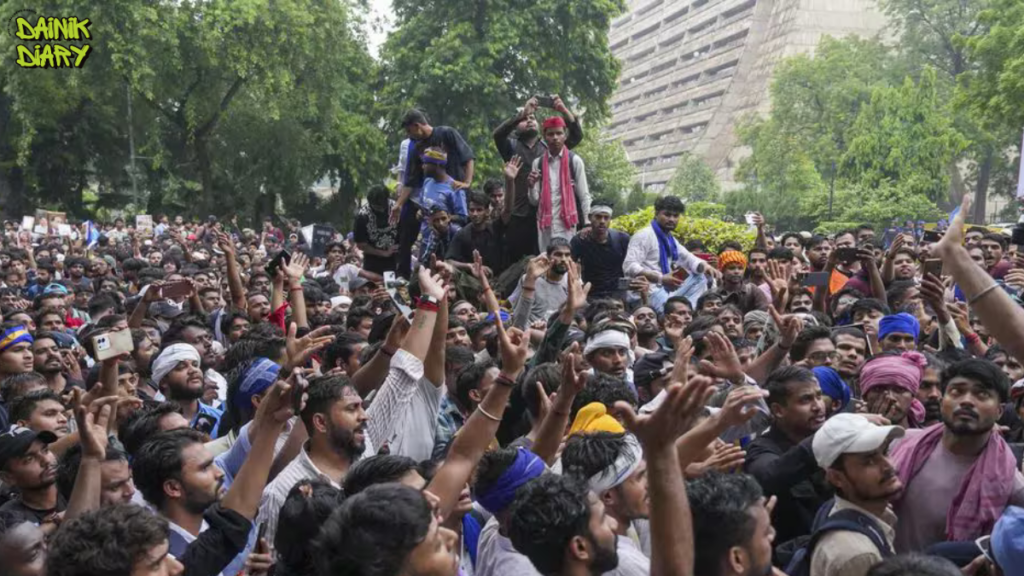
Political analysts believe that the Jantar Mantar mobilisation has reinforced the growing influence of Gen Z in India’s democratic landscape.
With a significant number of first-time voters expected to participate in upcoming elections, political parties are increasingly recognising the importance of sustained engagement on issues such as education, employment, skill development, and campus welfare.
The Delhi BJP’s latest strategy reflects an effort to strengthen its connection with younger citizens through continuous dialogue rather than episodic campaigns.
Whether this renewed outreach translates into lasting political support remains to be seen, but it clearly signals that student voices are becoming an increasingly important factor in shaping political strategies in the national capital.









Pingback: BJP Slams Rahul Gandhi, Congress Over Kerala Protest Cases, Alleges 'Double Standards' On Student Demonstrations - Dainik Diary - Authentic News