Sports
Curaçao Were Drawing 1-1 With Germany Then FIFA Called a ‘Water Break’ and Everything Fell Apart…
FIFA’s new mandatory hydration breaks at World Cup 2026 were meant to protect players from the North American summer heat. But one tiny nation’s dream of a historic upset died the moment the whistle blew for a drink.

There is a moment in every great upset — a window, fragile and brief — where the impossible starts to feel real. Curaçao had that moment. They were inside it. And then FIFA blew the whistle.
Not for a foul. Not for an injury. For a water break.
The Smallest Nation. The Biggest Stage. And One Unforgettable Goal.
Let’s set the scene properly, because this story deserves it.
Curaçao — a Caribbean island nation with a population of just over 150,000 people — is the smallest nation by population ever to qualify for a FIFA World Cup. Their journey to FIFA World Cup 2026 alone was the stuff of fairy tales. But nobody, not even their most devoted fans, could have predicted what happened next.
In Houston, under the blazing North American summer sun, Curaçao lined up against Germany — a four-time World Cup champion, one of the most feared footballing nations on the planet, a team built on steel, precision and decades of elite infrastructure.
And then Livano Comenencia scored.
1-1.
The Curaçao fans went absolutely wild. The Germans were visibly shaken. Cameras caught the disbelief in the stands, the raw joy on the faces of a small nation daring to dream out loud. A famous, legendary, once-in-a-generation upset was suddenly not just possible — it was happening, right there, in real time.
ALSO READ : No Team India at FIFA World Cup 2026, But These Players With Indian Roots Will Carry a Piece of the Nation’s Dream
The football world was watching.
Then Came the Water Break — And It Changed Everything
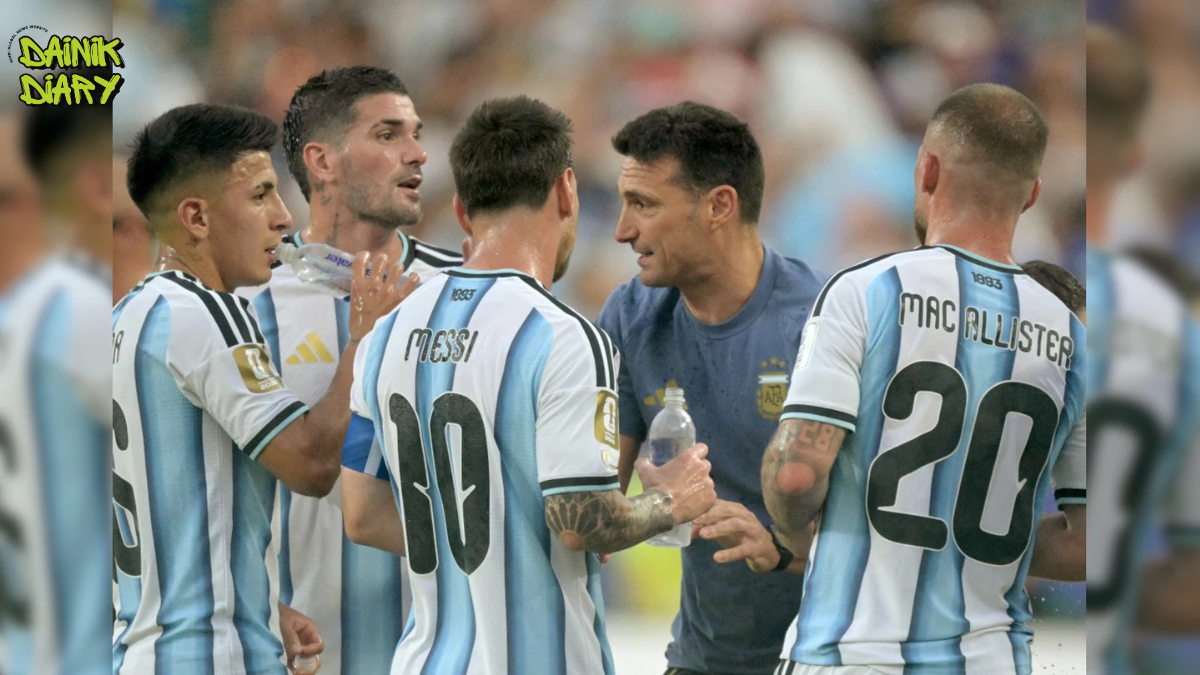
FIFA introduced mandatory hydration breaks at World Cup 2026 as a brand-new rule — one whistle midway through each half, where play stops completely and players from both sides hydrate and receive instructions from their coaching staff.
The idea, on paper, is perfectly reasonable. North American summers are brutal. Temperatures in Houston, Los Angeles and Miami can be unforgiving, and player welfare matters. FIFA wanted to ensure no one collapsed from heat exhaustion on the world’s biggest stage.
But what nobody fully accounted for was this: momentum in football is everything.
When that hydration break whistle blew with Curaçao level at 1-1 and the upset very much alive, something shifted. The pause — however brief — handed Germany’s coaching staff exactly the time they needed. Tactics were reset. Instructions were given. The German machine, briefly rattled, was recalibrated.
Curaçao, who had been riding a wave of pure adrenaline and belief, lost the initiative completely.
Within minutes of play resuming, Germany scored. Then scored again. Two goals before halftime. The dream, so vivid and electric just moments before, was gone.
The final scoreline? Germany 7 — Curaçao 1.
“FIFA Killed the Momentum” — Fans and Pundits React
It didn’t take long for the backlash to arrive.
Football fans across social media erupted, not at Germany’s dominance, but at the timing and impact of the hydration break. The consensus was uncomfortable but hard to dismiss — that a rule designed to protect players had, in this instance, accidentally protected the favourite and robbed a smaller nation of its greatest moment.
Pundits weighed in heavily. The core argument was simple: football is a game of momentum, emotion and chaos — and a mandatory, coach-instructed stoppage in the middle of that chaos is not a neutral event. It benefits the team with the better coaching staff, the deeper tactical knowledge, the calmer heads.
In other words — it benefits Germany, not Curaçao.
Critics began calling it “FIFA’s most controversial new rule” of the tournament, with many questioning whether the hydration breaks should at least be timed differently — or left to the referee’s discretion rather than enforced at a fixed point in each half.
A Rule With Good Intentions — But Serious Consequences
To be fair to FIFA, the intent behind the hydration breaks is not sinister. Heat management in sport is a genuine medical concern. Players at the 2026 World Cup are competing in venues where temperatures regularly climb past 35°C, and the physical toll of 90 minutes of elite football in such conditions is very real.
But good intentions don’t always produce good outcomes — and in the case of Curaçao vs Germany, the break came at arguably the worst possible moment for the neutral fan, and for the integrity of what was unfolding on that pitch.
There is also a broader, uncomfortable truth here: structured mid-game breaks favour teams with elite coaching staffs and deep tactical benches. The bigger nations — Germany, France, Brazil, Argentina — have rooms full of analysts, data specialists and world-class coaches who can make those 90 seconds count. Smaller nations, with limited resources, simply don’t have the same advantage.
FIFA’s new rule, however unintentionally, may have built a structural bias into the game that nobody voted for and nobody fully debated.
Curaçao’s Story Isn’t Over — But the Questions Must Be Asked
Despite the 7-1 defeat, Curaçao’s presence at this World Cup remains a historic achievement that their people should be enormously proud of. Livano Comenencia’s goal against Germany will be replayed in Willemstad for generations. That cannot be taken away.
But the football world now faces an honest conversation about FIFA’s hydration break rule — what it was designed to do, what it actually did, and whether the beautiful game is better or worse for it.
Because somewhere in Houston, a small island of 150,000 people was 45 minutes away from one of the greatest World Cup upsets ever recorded.
And then someone blew a whistle for a glass of water.