Politics
Vijay or Rahul Gandhi for PM in 2029? TVK-Congress rift deepens as minister raises resignation warning…
Months after joining hands to form the Tamil Nadu government, Chief Minister C. Joseph Vijay’s TVK and Congress are facing an emerging political fault line over who should lead the Opposition’s national challenge in the 2029 Lok Sabha elections.

A political partnership that dramatically reshaped Tamil Nadu after the 2026 Assembly elections is already facing one of its biggest tests.
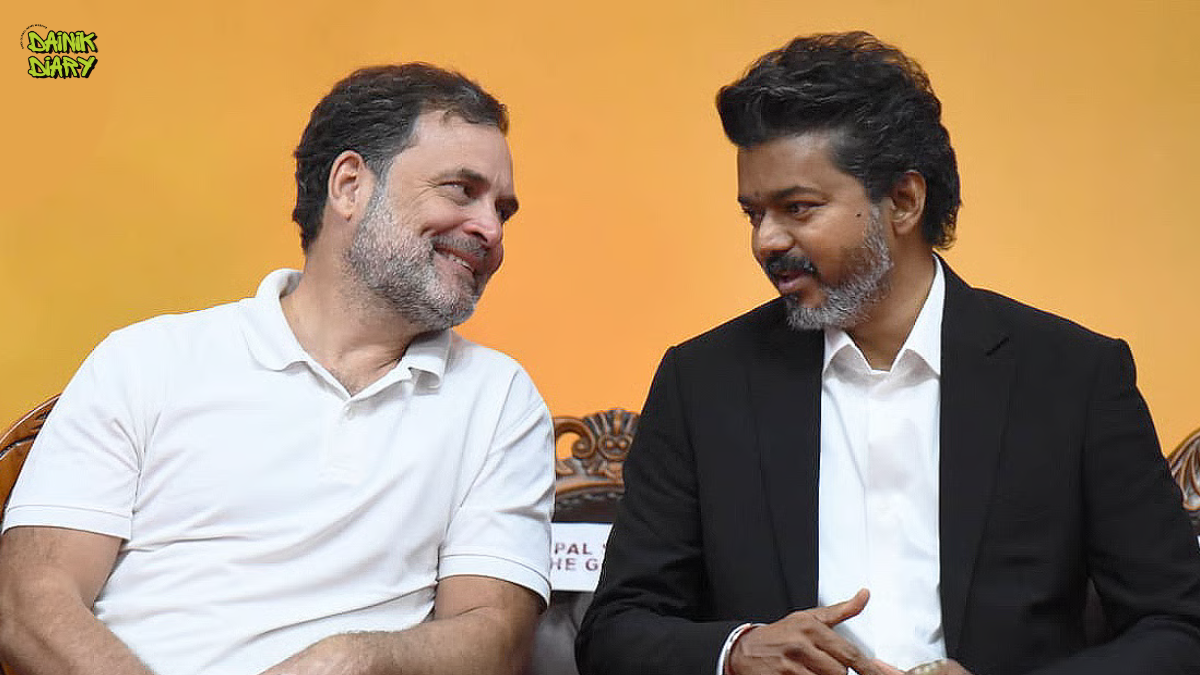
The alliance between Chief Minister C. Joseph Vijay’s Tamilaga Vettri Kazhagam (TVK) and the Congress has come under strain following competing statements over the Opposition’s potential prime ministerial face for the 2029 Lok Sabha elections.
At the centre of the dispute are two names — Vijay and Rahul Gandhi.
While a section of the TVK has begun talking about Vijay’s potential role on the national stage, Congress leaders have made it clear that their political preference remains Rahul Gandhi.
The disagreement is particularly significant because Congress, despite being a relatively small coalition partner, remains important to the numerical stability of the TVK-led Tamil Nadu government.
TVK minister pitches Vijay for national leadership
The controversy gained momentum after Aadhav Arjuna, a TVK leader serving as Public Works Department Minister, suggested that Vijay should be considered for a national leadership role.
His argument went beyond party politics. Arjuna reportedly pitched the idea that the country’s highest political office should have representation from Tamil Nadu, effectively placing Vijay’s name into an early and highly speculative 2029 prime ministerial conversation.
The remarks immediately created discomfort within the alliance.
For Congress, backing another coalition leader as a possible prime ministerial candidate would inevitably raise questions about Rahul Gandhi’s leadership at the national level.
Congress minister raises resignation possibility
The response from the Congress camp was unusually sharp.
State minister S. Rajesh Kumar indicated that Congress ministers could consider resigning from the Tamil Nadu cabinet if TVK ultimately refused to support Rahul Gandhi as its choice for prime minister in 2029.
That transformed what could have remained an exchange between individual leaders into a potentially serious coalition dispute.
The political message was difficult to miss: Congress may be a junior partner in Chennai, but it does not appear willing to compromise on the question of its national leadership.
With the 2029 Lok Sabha elections still years away, however, the timing of the disagreement has also raised questions about why the succession battle is emerging so early.
Assembly seating change adds to speculation
Signs of discomfort between the allies became even more visible inside the Tamil Nadu Assembly.
On August 31, Congress Legislature Party leader Tharahai Cuthbert was reportedly shifted from the section allotted to the ruling TVK alliance and seated in the front row of the opposition benches.
While seating arrangements alone do not determine the future of a coalition, the development attracted attention because it came against the backdrop of increasingly public disagreements between leaders of the two parties.
Together, the remarks and the Assembly episode have fuelled speculation over whether the alliance is experiencing a temporary disagreement or the beginning of a deeper political divide.
How Vijay changed Tamil Nadu politics
The stakes are high because of the extraordinary political transformation produced by the April 2026 Tamil Nadu Assembly elections.
Vijay’s relatively young political outfit, Tamilaga Vettri Kazhagam, won 108 of the 234 Assembly seats, emerging as the largest party but stopping short of the 118 seats required for an outright majority.
Vijay subsequently formed a coalition with Congress, VCK, IUML and MDMK, while receiving outside support from Left parties.
Together, the arrangement gave the coalition 121 seats, allowing Vijay to become Chief Minister and bringing an end to decades in which DMK and AIADMK had dominated the state’s electoral politics.
But those numbers also explain why disagreements with smaller partners cannot simply be ignored.
Why Congress’ five MLAs could matter
The Assembly currently has an effective strength of 227 members because of seven vacancies, putting the majority mark at 114.
Congress holds only five seats, but in a tightly balanced House, even a relatively small bloc can acquire significant bargaining power.
If political disagreements eventually translated into a withdrawal of support, the arithmetic surrounding the government could become considerably more complicated, depending on the position adopted by the other coalition partners and outside supporters.
For now, however, the disagreement remains primarily political. There has been no definitive breakdown of the governing coalition.
Can Vijay realistically become PM in 2029?
Behind the immediate controversy lies a much bigger question: Does Vijay have national ambitions?
His political rise has been remarkably rapid, but transforming regional popularity into a credible national prime ministerial bid would be an entirely different challenge.
Tamil Nadu sends 39 MPs to the Lok Sabha. Even if Vijay’s political alliance were to dominate all 39 constituencies in 2029, that number would remain far below the 272 seats normally required for a majority in the 543-member Lok Sabha.
That does not necessarily make a regional leader becoming prime minister impossible.
India has previously seen coalition-era prime ministers such as H.D. Deve Gowda and I.K. Gujral emerge through political consensus despite not commanding anything close to a parliamentary majority independently.
But the political circumstances that produced those governments were very different.
ALSO READ : ‘Even If He Ties a Bell Around a Dog, Vote for Him’: SP Leader’s Akhilesh Yadav Remark Sparks Political Firestorm in UP
The Arvind Kejriwal challenge
Another comparison inevitably emerges with Arvind Kejriwal.
The Aam Aadmi Party (AAP) demonstrated that a relatively new political organisation could disrupt established parties, build governments and expand beyond its original territory. Yet translating strong regional performances into nationwide electoral strength proved considerably more difficult.
Vijay could eventually encounter the same obstacle.
His celebrity, popularity and political appeal have already helped transform Tamil Nadu politics, but a national project would require organisational structures, candidates, alliances and voter recognition across multiple states with vastly different political cultures.
That would take considerably more than success in Chennai.
Vijay faces a delicate balancing act
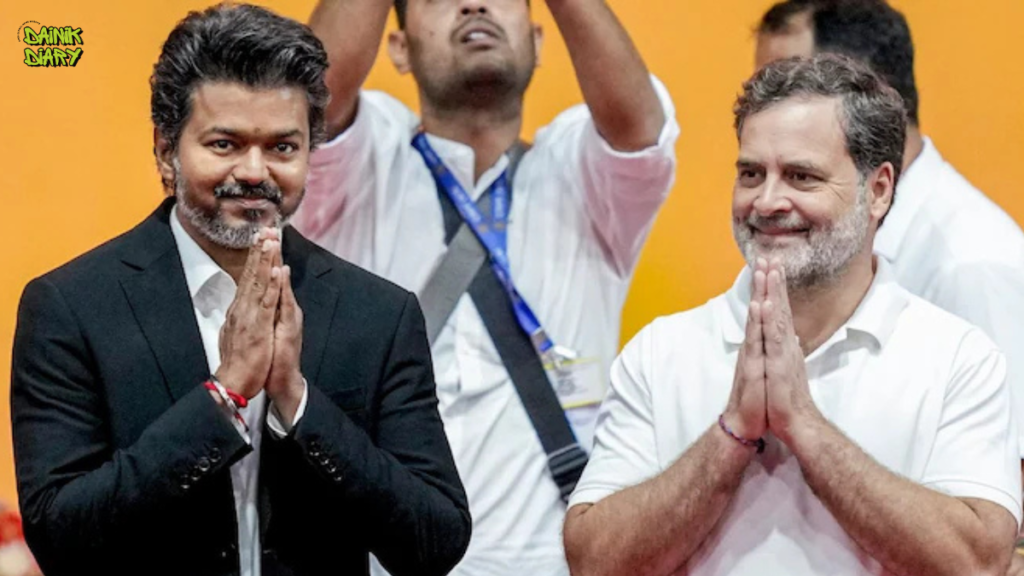
For the moment, Vijay’s immediate political challenge may not be Delhi, but maintaining stability in Tamil Nadu.
TVK must keep its own supporters energised while simultaneously managing coalition partners whose national priorities may be very different.
Congress, meanwhile, has its own balancing act. It benefits from participating in the state government but is unlikely to welcome a narrative in which Vijay begins competing with Rahul Gandhi for leadership of a future national Opposition coalition.
With the 2029 general election still some distance away, neither Vijay nor Rahul Gandhi’s eventual position can be taken for granted.
But the controversy has exposed an important contradiction inside the alliance much earlier than expected.
TVK and Congress came together to govern Tamil Nadu. The bigger question now is whether their partnership can survive when the conversation moves from who controls Chennai to who could eventually lead New Delhi.








Pingback: Rahul Gandhi Gets No Relief From Bombay High Court In ‘Commander-in-Thief’ Case Against PM Modi, But Court Gives Him 6 Weeks To… - Dainik Diary - Authentic News
Pingback: Aditya Thackeray Named By Disha Salian’s Father In CBI Statement; Satish Salian Says ‘I Told Them Everything That Happened…’ - Dainik Diary - Authentic News
Pingback: Did Mamata Banerjee Reach Out To Congress With A Nandigram Offer? What Was Allegedly Proposed And Why TMC Denies It - Dainik Diary - Authentic News