Politics
Kharge Writes to PM Modi Over Delimitation, Warns ‘Do Not Bulldoze’ Process as Special Parliament Session Buzz Grows
Congress chief seeks an all-party meeting, a 25-year freeze on the Lok Sabha’s 543-seat strength and women’s reservation from 2029


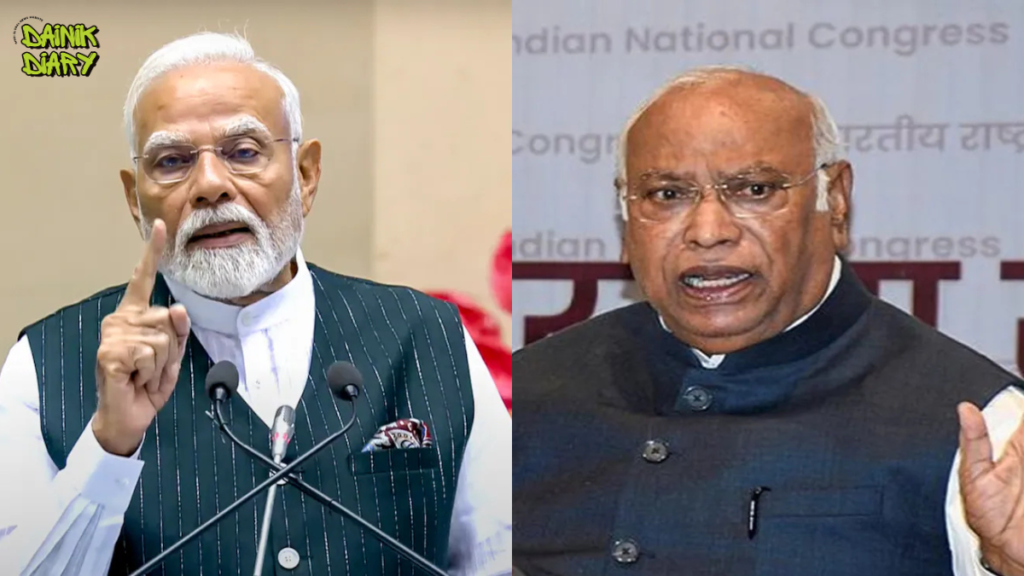
Congress President Mallikarjun Kharge has once again written to Prime Minister Narendra Modi, pressing the Centre to hold an all-party meeting before moving ahead with any fresh proposal on delimitation. His latest intervention comes amid renewed speculation that the government could call another sitting of Parliament or a special session.
In the letter dated August 27, 2026, Kharge said political parties and state governments must be given sufficient time to study any delimitation proposal before legislation is introduced. He argued that the issue carries major consequences for the country’s political and federal structure and should not be rushed through Parliament.
Kharge also reminded the Prime Minister that he had raised a similar demand in a letter on July 16, when he called for broader consultations over the government’s plans relating to delimitation and women’s representation.
Kharge says ‘do not bulldoze’ delimitation process
The Leader of Opposition in the Rajya Sabha used unusually sharp language while urging the government to proceed cautiously.
Calling delimitation an issue of “enormous significance for the country,” Kharge asked the Centre not to “bulldoze” the process, referring to developments during the special parliamentary proceedings on April 16 and 17, 2026.
His warning reflects a wider Opposition concern that any major change in the distribution of Lok Sabha seats could reshape political representation among states for decades.
Congress puts forward three key demands
Kharge reiterated the Congress party’s three-point position on the issue.
The party wants the existing strength of the Lok Sabha to remain at 543 seats for another 25 years. It also wants the current state-wise distribution of parliamentary seats to remain unchanged over the same period.
At the same time, the Congress has demanded that the 33% reservation for women in the Lok Sabha be implemented from the 2029 general election, but within the existing strength and distribution of seats.
The Opposition has broadly argued that it supports greater representation for women but does not want that reform tied to a delimitation exercise that could significantly alter the balance of political power between states.
Why delimitation has become politically sensitive
At the heart of the controversy is the possibility that a future delimitation exercise could use updated population figures to redistribute seats among states.
That has triggered particular concern in several southern states, where political leaders argue that states which successfully slowed population growth should not lose relative representation in Parliament compared with more populous states.
Critics of a purely population-based formula say it could increase the parliamentary weight of states with larger populations while reducing the influence of states that performed better on population control.
The issue has therefore become more than a technical exercise of redrawing constituencies. It has developed into a wider debate over federal balance, representation and political equality among states.
Southern leaders back freeze on Lok Sabha strength
The concern has found support among several political leaders in southern India.
The DMK has been among the strongest voices opposing any delimitation formula based solely on population. Party leaders, including Kanimozhi, have argued that such a system could effectively penalise southern states for their success in controlling population growth.
Similar concerns have been raised in Karnataka and Tamil Nadu, where political leaders have backed retaining the existing parliamentary strength and state-wise representation for a longer period.
The Tamil Nadu Assembly has also supported retaining the Lok Sabha’s strength at 543 seats, while favouring implementation of women’s reservation within the existing framework.
ALSO READ : UP Polls 2027: Yogi, Akhilesh Among 52 Leaders Given Bulletproof Jackets Ahead of Election
Special Parliament session speculation adds urgency
Kharge’s latest letter comes at a politically sensitive moment after Parliamentary Affairs Minister Kiren Rijiju left open the possibility of Parliament meeting again.
In a television interview, Rijiju said that when a House has not been formally prorogued, it can be summoned again. However, he stopped short of confirming that the government was preparing to call a special session.
The Monsoon Session of Parliament was adjourned sine die on August 13, but the delay in formal prorogation has fuelled speculation within Opposition ranks over whether another sitting could be called.
Kharge specifically referred to this delay in his letter, suggesting that the Parliamentary Affairs Minister’s remarks may explain why the Monsoon Session has not yet been formally prorogued.
Opposition wants consultation before any fresh Bill
For the Opposition, the immediate demand is not simply about rejecting delimitation.
Kharge has called for the government to first place its proposals before all political parties and state governments, allowing them enough time to examine the possible constitutional and political consequences.
The Congress argues that decisions affecting representation in the Lok Sabha should emerge from wider political consultation rather than being pushed through on a tight parliamentary timetable.
With debate over delimitation, women’s reservation and a possible special Parliament session gathering momentum, Kharge’s latest letter has ensured that the issue will remain at the centre of national political discussion.