
Business
Why Is the Stock Market Crashing Today? Sensex Tumbles Over 700 Points, Nifty Slips to 24,000 as 6 Major Factors Trigger Selloff
Escalating Iran-US tensions, rising crude oil prices, a weaker rupee and global market weakness weighed heavily on investor sentiment, dragging the Sensex and Nifty 50 sharply lower in Monday’s trade.

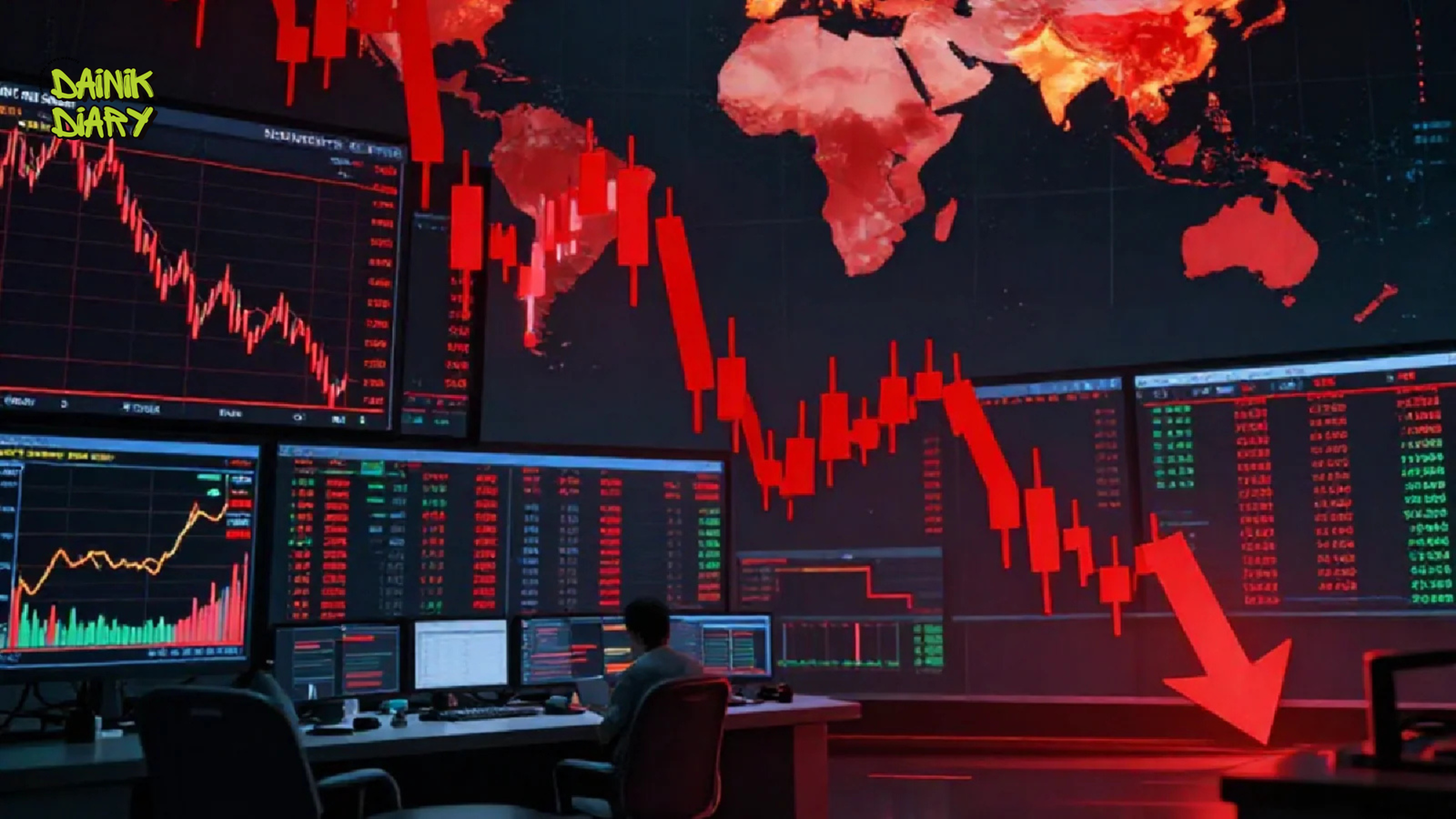
Mumbai: Indian equity markets witnessed a sharp selloff on Monday as global uncertainties and geopolitical tensions rattled investor confidence. The benchmark BSE Sensex plunged more than 700 points, while the Nifty 50 slipped close to the crucial 24,000 mark during intraday trading.
The broad-based decline erased over ₹2 lakh crore in investor wealth, bringing the total market capitalisation of companies listed on the Bombay Stock Exchange (BSE) to nearly ₹479 lakh crore.
While sectors such as automobiles, financial services and metals came under heavy pressure, information technology stocks managed to outperform the broader market.
Sensex and Nifty Under Pressure
During Monday’s session, the Sensex dropped around 712 points to trade near 76,857, while the Nifty fell more than 200 points, testing the psychologically important 24,000 level.
Among the biggest losers were IndiGo, Tata Steel, Asian Paints, Maruti Suzuki, Larsen_%26_Toubro, HDFC Bank, ICICI Bank, Mahindra & Mahindra, Bajaj Finance and UltraTech Cement.
On the other hand, IT heavyweights including TCS, Infosys, HCLTech and Tech Mahindra bucked the trend with modest gains.
Read More- “Crude Oil Crash to $70… But Petrol Prices Won’t Fall Yet? Inside the Government’s Big ‘Wait-and-Watch’ Strategy”
Broader indices also remained weak, while the India VIX, often referred to as the market’s fear gauge, surged more than 8%, indicating rising volatility.
Six Reasons Behind Today’s Market Fall
1. Fresh Escalation in the Iran-US Conflict
Investor sentiment deteriorated after renewed hostilities in the Middle East. Fresh military exchanges involving Iran and the United States raised concerns over regional stability, reversing the optimism created by the recent temporary ceasefire.
Growing geopolitical uncertainty has once again increased fears of disruptions to global trade and energy supplies.
2. Crude Oil Prices Climb Sharply
Oil prices surged after reports linked the conflict to renewed concerns surrounding shipping through the Strait of Hormuz—one of the world’s most important energy routes.
Brent crude climbed close to $79 per barrel, while WTI crude also registered strong gains.
Higher crude prices remain a major concern for India, which imports a significant portion of its oil requirements. Rising energy costs can widen the trade deficit and put pressure on inflation.
3. Rupee Weakens Against the Dollar
The Indian rupee opened lower against the US dollar as rising oil prices increased demand for foreign currency.
A weaker rupee generally raises import costs, particularly for crude oil, adding another layer of concern for investors.
Market participants are also awaiting upcoming US inflation data, which could influence global currency movements and foreign investment flows.

4. Rising US Bond Yields
Another factor weighing on equities was the increase in US Treasury yields.
Higher bond yields often encourage investors to shift money away from equities into relatively safer fixed-income assets, reducing risk appetite in stock markets worldwide.
5. Weak Global Markets
The weakness wasn’t limited to India.
Asian markets traded sharply lower, with South Korea’s Kospi, Japan’s Nikkei, China’s Shanghai Composite, and Hong Kong’s Hang Seng all ending in negative territory.
Although Wall Street had closed the previous session on a positive note, US futures indicated a weaker opening, further dampening sentiment across global markets.
6. Profit Booking After Recent Gains
Analysts also believe investors chose to lock in profits after the benchmark indices rallied strongly over the previous two trading sessions.
The Sensex had gained more than 1,000 points recently, prompting traders to book profits amid increasing geopolitical uncertainty.
What Should Investors Watch Next?
According to market experts, the trajectory of crude oil prices will remain the biggest factor influencing Indian equities in the near term.
Analysts believe that if Brent crude remains below $90 per barrel, the Indian market may avoid a major correction. However, a sustained rise above that level could increase pressure on corporate earnings, inflation and overall market sentiment.
Despite the recent selloff, steady Foreign Institutional Investor (FII) inflows continue to provide some support to Indian equities. Experts also note that global investors are increasingly viewing India as a relatively stable destination amid ongoing uncertainty in several international markets.
For traders, the coming sessions will largely depend on geopolitical developments, oil prices, global inflation data and the movement of foreign investment flows.