Politics
Dharmendra Pradhan calls Rahul Gandhi a “habitual liar” over Jharkhand protests: “Why is he silent today…?”
The BJP MP accused Congress of “selective democracy” as Rahul Gandhi criticised the use of force against protesting JPSC-JSSC aspirants in Ranchi.


New Delhi: The political battle over the ongoing students’ agitation in Jharkhand has intensified, with former Education Minister and Bharatiya Janata Party (BJP) MP Dharmendra Pradhan launching a sharp attack on Rahul Gandhi.
Pradhan on Tuesday accused the Leader of Opposition in the Lok Sabha of being a “habitual liar” and alleged that the Congress was using students’ concerns for political purposes. His remarks came amid protests by JPSC-JSSC aspirants in Ranchi over alleged irregularities in recruitment examinations.
In a post on X, Pradhan claimed that Congress was “spreading lies regarding students’ interests” and accused Rahul Gandhi of making what he described as “baseless” and “factless” allegations against Union Home Minister Amit Shah.
The BJP leader further alleged that Rahul Gandhi was avoiding discussions in Parliament while making political statements outside the House.
Pradhan said the government was prepared to discuss every issue in Parliament but accused Congress of disrupting proceedings. He argued that political parties should be willing to hear answers inside the House instead of creating a confrontation outside it.
Pradhan takes aim at Congress’ “selective democracy”
Taking his criticism further, Pradhan accused Congress of following what he called a “selective” approach to democracy.
According to the BJP MP, Congress was highlighting incidents involving students when it suited the party politically, while allegedly remaining silent over similar situations in states governed by the opposition.
Pradhan also referred to the police action during the Jharkhand student protests, saying that the alleged use of force against protesters had been seen across the country. He questioned why Rahul Gandhi, who frequently comments on political and social issues, was not speaking more forcefully on the matter.
His comments added another layer to an already heated political dispute surrounding the protests.
Rahul Gandhi had already criticised police action
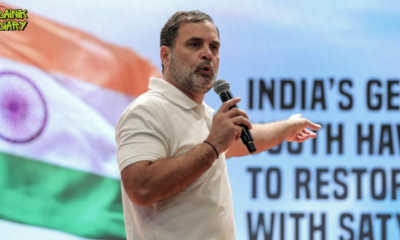
However, Rahul Gandhi had publicly reacted to the Jharkhand situation a day earlier.
The Congress leader criticised the use of force against protesting students and called for dialogue between the Jharkhand government and the agitating aspirants.
Gandhi said students have the right to protest peacefully and argued that dialogue was the way forward. He urged the state government to listen to the protesters and resolve their concerns.
The statement directly challenges Pradhan’s suggestion that Gandhi had remained silent on the Jharkhand police action.
ALSO READ : Rude Wake-Up Call for ’: Shashi Tharoor Says Gen Z Could Decide India’s 2029 Election Here’s Why It Matters
What triggered the Jharkhand student protests?
The agitation involves JPSC-JSSC aspirants, who have been protesting over alleged irregularities and concerns surrounding recruitment examinations, including the Jharkhand Staff Selection Commission Combined Graduate Level (JSSC-CGL) examination.
The protests intensified in Ranchi when a large number of aspirants marched towards the Jharkhand Assembly.
Police deployed water cannons, tear gas and lathi-charge during the confrontation after protesters reportedly breached barricades. Some protesters claimed that they were injured during the police action.
The developments have since become a political flashpoint, with the BJP and Congress trading accusations over the handling of the students’ movement.
Political fight grows around students’ demands

The controversy now extends beyond the examination-related grievances, with both sides accusing each other of politicising the issue.
For the BJP, Pradhan’s latest remarks are part of a broader attack on Rahul Gandhi and Congress over their handling of Parliament and student-related issues. For Congress, Rahul Gandhi’s criticism of the police action places the focus on the government’s responsibility to engage with protesting students.
As the Jharkhand agitation continues, the political temperature is likely to remain high, particularly with questions over recruitment examinations, alleged irregularities and the treatment of protesting aspirants still dominating the debate.
For now, the central issue remains the students’ demand for answers and a resolution to their concerns, while the political confrontation between BJP and Congress continues to intensify around it.