
Sports
Rohit Sharma silences his critics at Lord’s, but India’s real ODI problem is hiding somewhere else…
A stunning 138 at Lord’s may have answered the biggest question surrounding Rohit Sharma’s future, but India’s series defeat to England exposed deeper concerns over bowling depth, selection and succession planning.

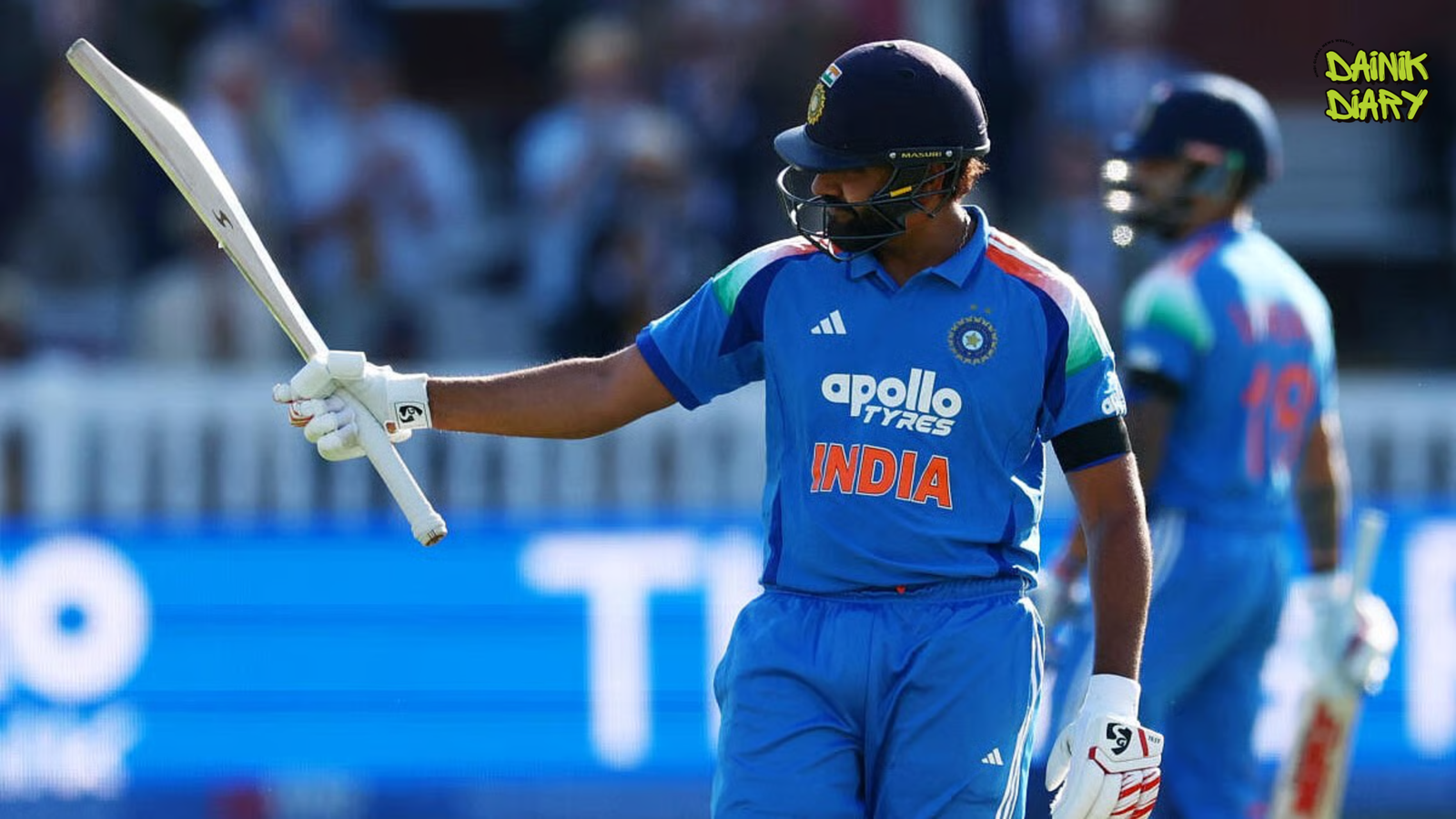
For the past few days, the conversation around Rohit Sharma had become less about cricket and more about a question that no player can escape forever: Is this the end?
At 39, with the 2027 ODI World Cup still more than a year away, Rohit’s place in India’s long-term plans had become a subject of intense debate. Reports suggested that the selectors were looking towards younger opening options, while names such as Yashasvi Jaiswal were naturally being mentioned as potential successors.
Then came Lord’s.
With his future being discussed outside the boundary, Rohit walked into the middle and produced an innings that made the entire debate look rather different.
The veteran opener smashed a magnificent 138 off 110 balls in the third ODI against England, becoming the first Indian batter to score an ODI century at the iconic Lord’s Cricket Ground.
India eventually lost the match by 27 runs and surrendered the series 2-1. But if the question was whether Rohit Sharma can still deliver when India desperately needs him, his answer was emphatic.
Yes.
And perhaps that is the question the selectors should have been asking all along.
Rohit Sharma answers the biggest question with the bat
The timing of Rohit’s century could hardly have been more dramatic.
Before the Lord’s decider, the Indian captain had gone eight ODI innings without scoring a fifty. The pressure was mounting, and speculation over his international future had reached fever pitch.
Yet, when India were handed a massive target of 388, Rohit did what he has done throughout much of his career.
He took responsibility.
The start was cautious, almost understandable given the circumstances. But once Rohit settled in, the familiar player emerged. His timing improved, the boundaries began flowing and the pressure gradually shifted towards England.
By the time he reached his century, the message was clear.
Rohit was not finished.
His 138 also took him past Sourav Ganguly‘s previous highest ODI score by an Indian batter at Lord’s, making the achievement even more memorable.
After the match, Rohit was asked about the noise surrounding his future. His response was characteristically calm.
Read More- Google Pixel 11 Launch on August 12: Big Storage Upgrade, Powerful Tensor G6 Chip and New Colours Could Be Coming…
“If there’s no noise, there’s no fun. My job is inside; their job is outside.”
He added that his focus remained on contributing to India’s success and making the most of every opportunity.
It was a statement that sounded less like a defence of his career and more like a reminder: judge him by what happens on the field.
But was it really just ‘outside noise’?
That is where the debate becomes more complicated.
Former India spinner Ravichandran Ashwin argued that the speculation around Rohit’s future was not entirely baseless.
“There is no smoke without fire,” Ashwin said, pointing out that there had clearly been discussions around India’s transition plans.
The BCCI selectors have already demonstrated that reputations alone will not guarantee a place in the team.

Rohit and Virat Kohli were moved on from Test cricket despite both wanting to continue. The decision showed that Indian cricket’s selection policy is increasingly focused on future planning rather than sentiment.
That makes the discussion around Rohit’s ODI future legitimate.
At 39, there is no guarantee that he will remain at his best when the 2027 World Cup arrives. Cricket is unpredictable, and the demands on a player only become greater with age.
But there is another side to the argument.
If Rohit is still scoring runs, maintaining his fitness and contributing to the team, should age alone become the reason to move him aside?
The Lord’s innings suggests the answer should be more complicated than a simple yes or no.
India’s bigger problem may not be Rohit at all
India’s defeat at Lord’s revealed something far more concerning.
When Jasprit Bumrah was unavailable, India’s bowling attack appeared to lose much of its bite.
England posted 387 for three, with India’s young and inexperienced pace attack struggling to contain the hosts.
Gurnoor Brar conceded 97 runs from his 10 overs without taking a wicket, while Arshdeep Singh and Prince Yadav also found it difficult to maintain control. Prasidh Krishna, with two wickets, was the only Indian pacer to offer significant resistance.
The result was a familiar concern.
India looked heavily dependent on Bumrah.
That is not a Rohit Sharma problem.
It is a squad-depth problem.
India captain Shubman Gill himself acknowledged concerns about player availability and injuries, noting that repeated absences force the team to constantly change its combination.
For a side preparing for a World Cup, that should be a bigger concern than whether a 39-year-old opener scored a century.
The Mohammed Siraj question
Another issue is the treatment of Mohammed Siraj.
Since the 2023 ODI World Cup, Siraj has featured in only a fraction of India’s ODIs and was not included in the Champions Trophy squad. He was also absent from the England ODI series.
Given his experience and ability to bowl in a variety of conditions, his continued absence raises questions about India’s broader selection strategy.
If India wants to build a reliable bowling unit for the 2027 World Cup, it needs to know exactly which players are part of the plan.
That clarity appears to be missing.
India’s succession plan needs more clarity
Experimenting with youngsters is not a bad idea.
In fact, it is essential.
But experimentation without a clear roadmap can create confusion.
India has tried different combinations while players such as Suryansh Shedge, Shivam Dube and Harsh Dubey have appeared in and around the setup without a clearly defined pathway.
The same uncertainty surrounds the future of Ravindra Jadeja, whose absence from recent ODI squads has not come with a clear explanation.
If the selectors have decided to move on, they should say so.
If they still consider these players part of the future, they need to give them meaningful opportunities.
A World Cup squad cannot be built through random appearances and emergency injury replacements.
Then there is Kuldeep Yadav
Perhaps the biggest selection puzzle of all is Kuldeep Yadav.
The left-arm wrist-spinner has taken 194 ODI wickets in 121 matches and has been one of India’s most effective bowlers in overseas conditions.
Yet, he did not play a single game in the England ODI series.
That is difficult to ignore.
India’s bowling looked one-dimensional at Lord’s, particularly without Bumrah. Kuldeep’s ability to provide a different challenge to opposition batters could have offered India an additional attacking option.
Former India batter Mohammad Kaif went as far as questioning whether Kuldeep’s continued exclusion could force him to reconsider his international future.
Whether that assessment is too harsh or not, the larger point remains valid.
India needs a clear bowling blueprint.
It needs to know who its frontline bowlers are, who the backups are and which young players are genuinely being groomed for the future.
Rohit has answered his part of the question
Rohit Sharma may not have control over what the selectors think.
He cannot decide how long his body will remain at its peak.
He cannot control the emergence of younger players.
But he can control what he does when he walks onto the cricket field.
At Lord’s, he answered the only question that truly mattered to him.
Can he still produce a match-defining innings under immense pressure?
He did.
India lost the game, but Rohit was not the reason.
The defeat instead exposed concerns around India’s bowling depth, injuries, selection consistency and the lack of a clearly visible succession plan.
If the goal is to win the 2027 ODI World Cup, India certainly needs to think about the future.
But perhaps the selectors should be careful not to confuse transition with replacement.
Rohit Sharma’s Lord’s century did not guarantee him a place in India’s World Cup squad.
What it did prove, however, is that Rohit himself may not be India’s biggest ODI problem.
The real challenge is figuring out how to build a team strong enough to compete when the likes of Bumrah are unavailable—and creating a succession plan that is clear, consistent and actually gives India’s next generation enough time to prove themselves.
That is the problem India needs to solve.
And it has nothing to do with one 39-year-old opener scoring 138 at Lord’s.



Pingback: Shubman Gill Misses Out On Series Win, But Gets Huge Reward: India Captain Is Now Just One Point Away From No.1… - Dainik Diary - Authentic News
Pingback: India's Injury Crisis Deepens: Shubman Gill's Sharp Remarks Raise Big Questions Over BCCI's Fitness System... - Dainik Diary - Authentic News