Tech
Samsung Galaxy S26 Review: It Looks Familiar, But Wait Until You See What Changes After a Few Weeks…
Samsung’s latest flagship doesn’t reinvent the Galaxy S series, but a brighter display, Exynos 2600 chip, smarter AI, bigger battery and refined software make the Galaxy S26 a quietly compelling upgrade.

The Samsung Galaxy S26 is not the kind of smartphone that tries to shock you the moment you take it out of the box. There is no dramatic redesign, no radical change in the camera system and no single headline feature that completely transforms the Galaxy experience.
Instead, Samsung has taken a more familiar approach with its latest flagship. The company has kept the formula largely intact and worked on the details that users experience every day.
And that may be the Galaxy S26’s biggest strength.
At first glance, it can feel as though Samsung has simply polished last year’s Galaxy S25 and given it a new name. But spend a little more time with the phone, and the improvements begin to reveal themselves. The new Exynos 2600 processor is a significant step forward, the display is brighter, the battery is larger, the software feels smarter and the AI features are gradually becoming more useful rather than simply being impressive demonstrations.
Of course, the question remains: is that enough to justify the higher price?
A familiar design that still feels premium
The Galaxy S26 follows the design language that Samsung has established over the past few generations. Measuring 149.6 x 71.7 x 7.2mm and weighing 167 grams, the phone remains compact enough to use comfortably with one hand.
The biggest visual change is at the back.
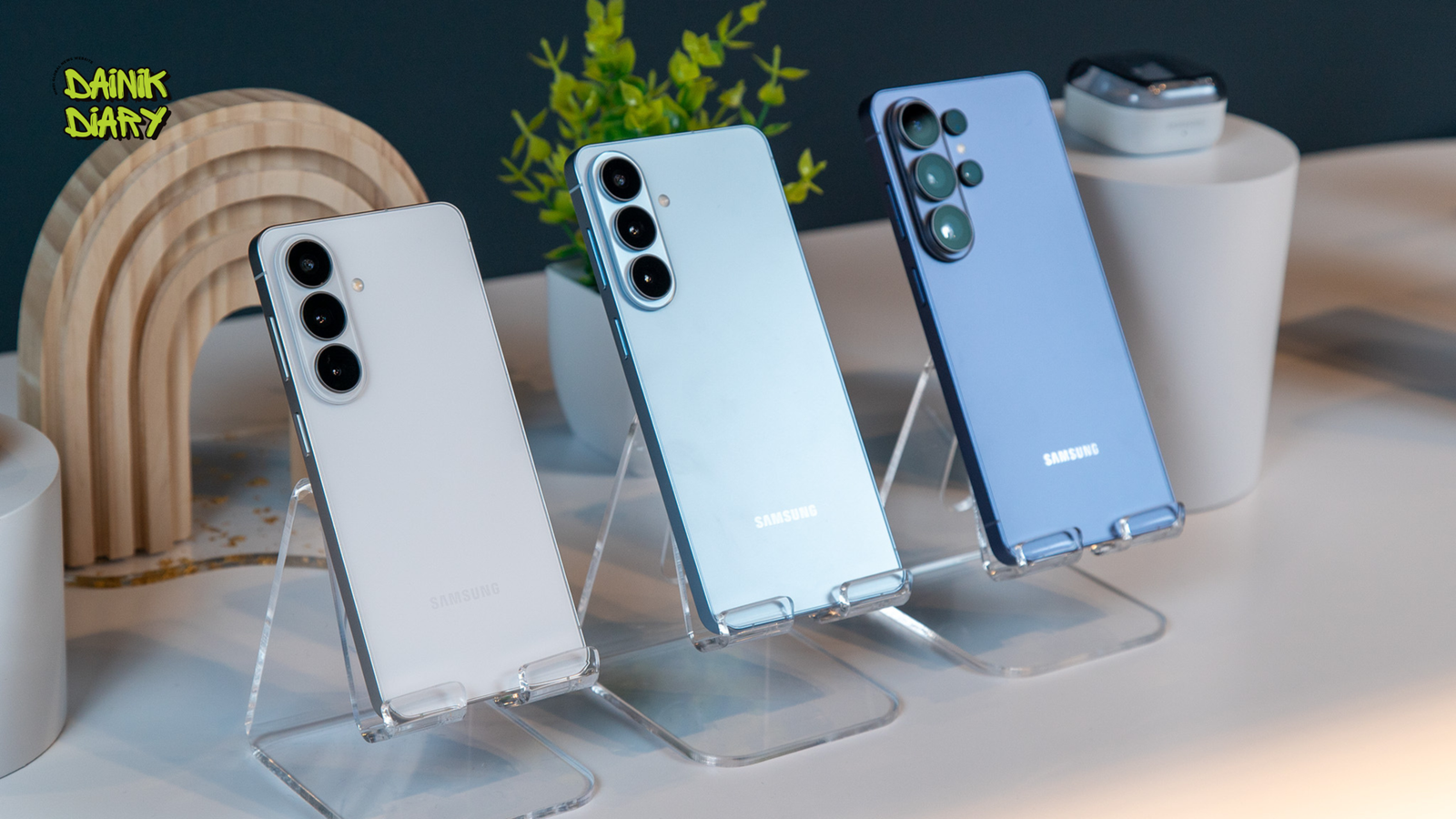
The three rear cameras are now housed together inside a unified circular camera module rather than appearing as separate floating rings. It is a subtle change, but one that gives the handset a cleaner and more deliberate appearance.
Samsung has also reduced the bezels around the screen, allowing the company to increase the display size from 6.2 inches on the Galaxy S25 to 6.3 inches without making the phone significantly larger.
The aluminium frame has a matte finish, while the flat rear panel adds to the phone’s understated premium character. Gorilla Armor protection and an IP68 rating for dust and water resistance further strengthen its flagship credentials.
The Galaxy S26 is offered in colour options including Cobalt Violet, Sky Blue, Black, White, Silver Shadow and Pink Gold. The Sky Blue finish, in particular, gives the phone a subtle appearance without being overly flashy.
This is still a Galaxy S phone that feels easy to live with. Those who found the Ultra models too large will appreciate the S26’s compact footprint.
Read More- Infinix Note 60 Pro Gets a Stylish Makeover in India: Two Premium Metallic Colours Arrive With Free Gifts and AI Perks
The 6.3-inch display is one of the phone’s biggest wins
The 6.3-inch Dynamic AMOLED 2X panel is one of the Galaxy S26’s strongest features.
It offers a Full HD+ resolution of 2340 x 1080 pixels and a 120Hz adaptive refresh rate that can drop down to 1Hz when the content on screen is static. That combination makes scrolling feel smooth while helping conserve battery when the display does not need to refresh constantly.
Peak brightness reaches 2,600 nits, making the screen easy to view outdoors, even under harsh sunlight.
Colours are vibrant, but Samsung appears to have moved further away from the excessive saturation that once defined its smartphone displays. The result is a panel that looks punchy while still maintaining a more natural presentation.
Watching HDR content is also enjoyable, with the display working alongside AKG-tuned stereo speakers to deliver a strong multimedia experience.
However, Samsung continues to reserve some of its most advanced display technology for the Galaxy S26 Ultra. The standard S26 does not receive the new Privacy Display, nor does it get the anti-reflective coating that has remained an Ultra-exclusive feature.
For most users, these omissions will not be deal-breakers, but at this price point, some buyers may wonder why Samsung continues to hold back features that could improve the everyday experience.
Exynos 2600 finally gives Samsung something to prove
For Indian buyers, the processor is perhaps one of the most interesting aspects of the Galaxy S26.
The Indian variant runs on Samsung’s own Exynos 2600, while the US model reportedly gets the Snapdragon 8 Elite Gen 5.
Historically, Exynos-powered Galaxy flagships have faced criticism over heat management, efficiency and battery life. Samsung appears determined to change that perception with the Exynos 2600.

Built using a 2nm manufacturing process, the new chipset delivers a noticeable performance improvement. During everyday use, the phone handles demanding tasks with ease, whether that means gaming, navigation, photography or running several applications at once.
The more encouraging part is that the phone does not appear to suffer from the overheating problems that have affected some previous Exynos-powered Galaxy devices.
Battery performance is also better than the previous generation. The 4,300mAh battery can comfortably last through a full day for most users.
However, the charging technology remains one of the Galaxy S26’s weakest points. The phone supports only 25W wired charging and 15W wireless charging. At a time when competing smartphones are offering considerably faster charging, Samsung’s decision to stick with these speeds is becoming increasingly difficult to defend.
Storage, thankfully, receives a much-needed upgrade. The base model now starts at 256GB, up from 128GB on the Galaxy S25. The phone also comes with 12GB of RAM across its configurations.
Galaxy AI is becoming useful—but Samsung still has a question to answer
The Galaxy S26’s most noticeable evolution may not be hardware at all.
It is the software.
Samsung’s Galaxy AI ecosystem continues to expand, and some features now feel considerably more mature than they did on previous-generation devices.
Now Brief, for example, has become more personalised. Instead of simply presenting generic information such as weather updates, it can surface useful reminders, birthdays, bookings and other information based on a user’s activity.
Then there is Now Nudge, which attempts to understand what is happening on the screen and suggest useful actions.
If a friend sends a message about meeting at a restaurant, the feature can offer directions. If an email contains a meeting date, it can provide a shortcut to add the event to the calendar.
These features do not always appear, and that is arguably a good thing. The AI is most useful when it stays in the background instead of constantly demanding attention.
Google Gemini continues to handle many of the more advanced AI tasks, including summaries, reminders and cross-app actions. Its performance has improved, although users should still be cautious about relying on AI for important information without verification.
Bixby, meanwhile, has received a more meaningful upgrade than many might expect. Samsung’s voice assistant is now better at understanding natural-language commands for controlling device settings. For simple actions such as enabling Do Not Disturb or adjusting phone settings, Bixby can sometimes be more convenient than launching Gemini.
Samsung has also brought Perplexity into the wider AI ecosystem. The idea is interesting, particularly for users who want AI-powered search and current information. However, some of the promised integration still feels incomplete.
And that raises an interesting question for Samsung: with Galaxy AI, Gemini, Bixby and Perplexity all competing for attention, which assistant is actually supposed to be the primary AI experience?
One feature that stands out is Scam Detection. Rather than being another flashy AI trick, it addresses a genuine problem by analysing suspicious patterns during calls and warning users. The feature works on-device, making it one of the more practical AI additions to the Galaxy experience.
Meanwhile, One UI 8.5 brings several smaller improvements. Quick settings now feels more convenient with vertical brightness and volume sliders, animations are smoother and notification management has been refined.
These are not changes that will dominate headlines, but they contribute to something more important: making the phone nicer to use every single day.
Samsung’s promise of seven years of operating system and security updates also gives the Galaxy S26 a strong long-term advantage.
The cameras haven’t changed much—but they still deliver
The Galaxy S26’s camera hardware is perhaps the clearest example of Samsung taking an evolutionary approach.
The phone features a 50-megapixel primary camera, a 12-megapixel ultrawide camera and a 10-megapixel telephoto lens with 3x optical zoom.
The hardware is familiar. In fact, the sensors have been used across Samsung’s flagship lineup for several generations.
Yet the results remain reliable.
The main camera captures detailed photographs with strong dynamic range and vibrant colours. The ultrawide camera maintains a consistent colour profile, making it easier to switch between lenses without getting noticeably different-looking images.
The 3x telephoto camera is dependable within its optical range, although the Galaxy S26 cannot compete with the more advanced camera hardware available on the Ultra model.
Night photography remains a strong point. Images are generally clean and detailed, without the overly processed appearance that has affected smartphone night photography in the past.
The 12-megapixel autofocus selfie camera also performs well, delivering natural skin tones and better portrait separation.
Video recording has received an interesting upgrade through Horizontal Lock, which keeps footage level even while the user is walking, turning or moving quickly.
It is a surprisingly useful feature for anyone who records video on the move. The only annoyance is that it needs to be manually enabled again when returning to video mode.
Samsung’s Photo Assist tools are also becoming more sophisticated. Users can describe certain edits in natural language, allowing AI to make changes such as removing background clutter or adjusting exposure.
The results are not perfect every time, but the feature has clearly moved beyond the gimmick stage.
Samsung also adds a watermark to images modified using AI, which is a sensible step as AI-generated and AI-edited content becomes increasingly difficult to distinguish.
So, should you buy the Galaxy S26?
The answer depends heavily on which phone you currently own.
If you are upgrading from the Galaxy S24 or an older device, the Galaxy S26 makes a strong case for itself. The improved processor, bigger battery, larger base storage, smarter AI features and refined software experience combine to create a meaningful upgrade.
But if you already own the Galaxy S25, the situation is less straightforward.
The design is extremely familiar. The camera hardware remains largely unchanged. Charging speeds have not improved, and the overall experience is evolutionary rather than revolutionary.
The Galaxy S26 is reportedly priced at around Rs 1,08,999, making it more expensive than its predecessor. That means buyers will naturally expect the improvements to justify the additional cost.
For some users, they will.
The Galaxy S26 is the kind of phone that grows on you. It does not necessarily impress with one spectacular feature. Instead, it delivers a collection of small improvements that become more noticeable the longer you use it.
The Exynos 2600 is more competitive, the display is excellent, the battery comfortably gets through the day and Galaxy AI is finally beginning to feel genuinely useful.
The unchanged camera hardware and slow 25W charging remain difficult to overlook, especially at this price.
But overall, Samsung has created a flagship that feels more polished than its predecessor.
The Galaxy S26 may not be the most exciting upgrade in the Galaxy S series’ history. But sometimes, the best smartphone improvements are the ones you stop noticing because they simply make everyday life easier.
For Galaxy S24 owners and users of older Samsung flagships, the Galaxy S26 is worth serious consideration. For Galaxy S25 owners, however, waiting for the next generation may be the smarter move.