Automobile
Maruti Baleno facelift drops a cylinder, gains Level 2 ADAS: The popular hatchback just got a surprising upgrade…
The 2026 Maruti Baleno facelift gets a new three-cylinder petrol engine, sharper styling, ventilated seats and Level 2 ADAS, while continuing to target buyers looking for a practical premium hatchback.

The Maruti Suzuki Baleno has been one of India’s most successful premium hatchbacks. Even as compact SUVs continue to dominate showroom conversations, the Baleno has maintained a strong presence among buyers looking for a practical, spacious and efficient car.
Now, Maruti Suzuki India has given the Baleno a mid-life update — and there is one change that immediately grabs attention.
The Baleno has lost a cylinder, but gained considerably more technology.
The facelifted hatchback now uses a new 1.2-litre three-cylinder Z12E petrol engine instead of the earlier four-cylinder K-Series unit. At the same time, Maruti has added Level 2 ADAS, ventilated front seats, a new audio system, tyre-pressure monitoring and additional safety equipment.
The Baleno gets a fresh face
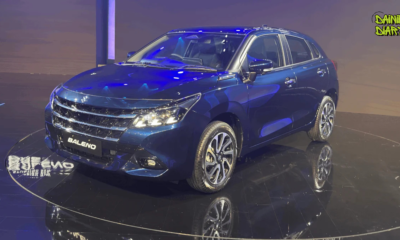
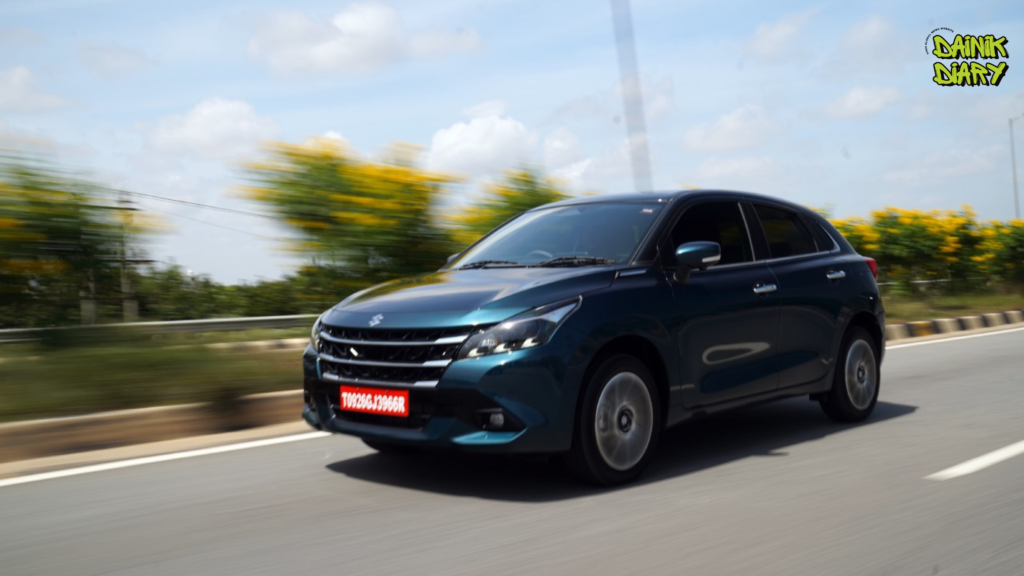
The facelift does not completely transform the Baleno’s design, but the changes at the front are noticeable.
The grille is now larger and features three horizontal chrome slats along with gloss-black detailing. The radar module for the new ADAS system is integrated into the centre section.
The bumper has also been redesigned, while the Suzuki badge has been moved above the grille. The familiar LED headlamps and three-block DRL design continue.
Move towards the side and the changes become more subtle. There is a new chrome garnish on the front fender and a shark-fin antenna, while the existing chrome window strip, chrome door handles and 16-inch alloy wheels continue.
At the rear, the Baleno remains almost unchanged, retaining its C-shaped LED tail-lamps, chrome tailgate strip and roof spoiler.
A new Enigmatic Teal Green colour is also part of the facelift’s palette.
Cabin remains familiar, but features get a boost
Inside, the overall dashboard layout remains familiar. The layered dashboard, flat-bottom steering wheel and black-and-blue theme continue.
However, the steering wheel now gets dedicated controls for adaptive cruise control and lane-keeping assistance. There are also additional controls near the start/stop button for managing selected ADAS functions.
The seats continue with fabric upholstery but receive leatherette detailing around the edges, giving the cabin a slightly more premium feel.
The biggest comfort addition is ventilated front seats, which should be especially useful during India’s warmer months.
The cabin continues to offer practical storage spaces, including large door pockets, a glove box, centre-console storage, cup holders and a small storage area underneath the armrest.
Rear passengers haven’t been forgotten
One of the Baleno’s long-standing strengths is its spacious rear seat.
Even taller passengers get useful headroom and legroom, while the under-thigh support makes longer journeys more comfortable. Maruti has also added an adjustable headrest and a three-point seatbelt for the centre rear passenger.
Rear occupants get dedicated AC vents and USB charging ports, adding to the car’s family-friendly character.
Boot space remains at 318 litres, and the car gets a spare wheel underneath the boot floor.
Level 2 ADAS is the biggest upgrade
This is arguably the most important addition to the new Baleno.
The top-spec Alpha (O) variant gets a Level 2 ADAS package that uses camera and radar technology. The system supports features such as automatic emergency braking, adaptive cruise control, lane-keep assist, lane-departure warning and other driver-assistance functions.
The addition is significant because advanced ADAS technology is still not common across premium hatchbacks in this price range.
However, ADAS should not be confused with autonomous driving. These systems are designed to assist the driver and do not remove the driver’s responsibility for controlling the vehicle.
The updated Baleno also gets six airbags as standard, along with electronic stability control, ABS with EBD, hill-hold assist, parking sensors, tyre-pressure monitoring and Isofix child-seat mounts.
The top variant also gets a 360-degree camera, although image quality is not the strongest aspect of the system.
The surprising engine change
Under the bonnet is where the biggest mechanical change has taken place.
The old 1.2-litre four-cylinder K-Series engine has been replaced by the 1.2-litre Z12E three-cylinder petrol engine.
The new engine produces around 83hp and 112Nm, which is slightly less power than the outgoing unit.
At first glance, losing a cylinder and some power might sound like a step backwards. But there is another side to the story.
The new Z-Series engine is designed to deliver better fuel efficiency and lower emissions. The same engine family is already used in models such as the Maruti Suzuki Swift and Dzire.
In everyday city driving, the engine’s low-speed response is smooth and predictable. There is some three-cylinder vibration and sound at idle, but it settles down as the revs rise.
It may not feel as eager as the outgoing four-cylinder engine at higher revs, but for daily commuting, the new motor is well suited to the Baleno’s character.
Manual, AMT and CNG options
The Baleno facelift continues to offer a five-speed manual as well as a five-speed AMT.
The manual gearbox gets a light clutch and relatively short gear throws, making it easy to operate in heavy traffic.
The AMT is aimed at buyers who prioritise convenience, although it does not offer the same smoothness associated with CVTs or DCTs.
A factory-fitted CNG option is also available. On CNG, the engine produces 70hp and 102Nm.
Mileage gets better
The new engine’s biggest advantage is efficiency.
The petrol-manual Baleno claims 23.80kmpl, while the AMT version is rated at 24.77kmpl. The CNG version claims an impressive 33.61km/kg.
Actual mileage will vary depending on traffic, driving style, road conditions and vehicle load, but the improvement in claimed efficiency gives the new engine a clear advantage for buyers focused on running costs.
Comfort remains a Baleno strength
The Baleno continues to focus more on comfort than outright driving excitement.
Its suspension is tuned towards a softer setup, allowing it to deal with most everyday road imperfections without much drama. Larger potholes can still unsettle the car, but the overall ride remains comfortable.
The steering is light at low speeds, making the Baleno easy to manoeuvre in crowded streets and parking areas. It becomes heavier as speeds increase, providing better confidence on highways.
It may not be the most exciting hatchback to drive, but its predictable handling and comfortable ride fit its intended role well.
Maruti Baleno facelift price and rivals
The facelifted Maruti Baleno is priced between ₹5.99 lakh and ₹9.99 lakh ex-showroom, depending on the variant and powertrain.
Its main premium-hatchback competitors include the Hyundai i20, Tata Altroz and Toyota Glanza.
The top-spec Alpha (O) is particularly interesting because it combines the Baleno’s familiar practicality with features such as Level 2 ADAS and ventilated seats.
The Baleno has lost a cylinder — but gained a lot more
The new Baleno is not a dramatic reinvention. Instead, Maruti Suzuki has focused on the areas that matter to modern buyers.
The exterior gets a sharper front design, the cabin receives useful comfort upgrades, safety technology takes a major step forward and the new engine promises improved efficiency.
Yes, the move from four cylinders to three may initially sound like a downgrade. But the change also brings lower emissions and better claimed fuel economy, while the addition of Level 2 ADAS gives the Baleno a technology advantage in an increasingly competitive segment.
So, the facelift’s biggest story may not actually be that the Baleno lost a cylinder.
It is what Maruti added in return.