World News
‘Trump Didn’t Deliver What He Promised’: Cracks Appear in MAGA Base as Inflation, Iran War Fuel Voter Frustration
Interviews with voters across competitive US congressional districts suggest some longtime Donald Trump supporters are becoming more willing to question his record, with rising living costs, the Iran war and government spending emerging as key concerns ahead of the 2026 midterm elections.


Washington: Is Donald Trump’s MAGA base beginning to show signs of strain?
That question is gaining attention ahead of the 2026 US midterm elections after interviews with voters across several politically competitive congressional districts found some longtime Trump supporters openly expressing disappointment with the president.
From concerns over inflation and rising household expenses to frustration with the ongoing Iran conflict, some voters who previously backed Trump repeatedly now say his second-term presidency has not unfolded the way they expected.
The interviews, conducted by NBC News during a journey along Interstate 80 from New Jersey to Nebraska, covered around four dozen voters across several battleground congressional districts.
Not everyone has turned against Trump — many remain firmly behind him — but the willingness of some previously loyal supporters to openly criticise the president could be significant with control of Congress at stake.
‘I Used to Be a Trump Man’
Among the most striking reactions came from Bob Gorra, an 89-year-old retiree living near New Jersey’s competitive 7th Congressional District.
“I used to be a Trump man,” Gorra told NBC News.
But his assessment of the current situation was considerably less enthusiastic.
Gorra said he was concerned about inflation, poverty and economic hardship, before adding that Trump “really didn’t deliver what he promised.”
His remarks capture one of the biggest political risks facing the president and the Republican Party: voters who may still share parts of Trump’s worldview but are increasingly judging his administration on the cost of everyday life.
Iran War Becomes Another Source of Frustration
The economy isn’t the only issue creating doubts.
In Hazleton, Pennsylvania, 38-year-old Louis Marcelino said rising prices and the war with Iran had left him uncertain about whether he would even vote in November.
“Everything has just gotten more expensive,” he said.
Another Pennsylvania voter, Rich Ehrhardt, 55, questioned the administration’s handling of the Iran conflict and suggested that Trump had moved away from promises to avoid prolonged foreign wars.
His frustration reflects a potentially sensitive issue for Trump, whose political movement has frequently criticised America’s involvement in lengthy overseas conflicts.
The Iran war has also become closely connected to Americans’ economic concerns, particularly through its effect on energy markets and fuel prices.
Recent Reuters/Ipsos polling found Trump’s approval rating at 33%, while support for US military action against Iran had fallen to 31%. Support for the conflict among Republicans was considerably higher, but had also declined.
‘Like He’s Being a King Instead of a President’
Trump’s spending priorities have also drawn criticism from some voters.
In Iowa, 75-year-old Darcey Liljequist criticised the decision to demolish the White House East Wing as part of plans for a new ballroom.
“It’s kind of like he’s being a king instead of a president,” she said.
Such remarks illustrate how voter concerns are extending beyond inflation and foreign policy to questions about Trump’s governing style and priorities.
But these interviews should not be read as evidence that the entire MAGA coalition is abandoning Trump.
Far from it.
Many Trump Voters Aren’t Going Anywhere
Other Republican voters interviewed remained strongly supportive of the president despite acknowledging problems with his administration.
Gunner Arellano, a Marine veteran in Omaha, compared abandoning Trump during a difficult political period to “changing drivers in the middle of a snowstorm.”
Ohio voter Katie Heinz continued to praise Trump’s “business sense,” although she said she wished the president would “ruffle feathers” less frequently.
Meanwhile, Iowa farmer Craig Rath said his loyalty to Trump “hasn’t wavered,” even while acknowledging the impact of tariffs on his industry.
These reactions highlight the complicated political picture facing Republicans: dissatisfaction does not automatically translate into defection.
Some voters may criticise Trump on specific issues while still supporting Republican candidates when they reach the ballot box.
ALSO READ : Trump Warns Iran ‘We Will Hit Very Hard Tonight’: Why Kharg Island Has Suddenly Become The Center Of A Dangerous New Standoff
Trump’s Approval Rating Adds to Republican Concerns
The individual voter interviews come against a difficult national polling backdrop for the president.
A recent Reuters/Ipsos poll placed Trump’s overall approval rating at 33%, matching a record low in his presidency.
The same survey found declining enthusiasm for the Iran war, with only 31% of Americans supporting military action. The conflict and higher fuel costs have become particularly important political vulnerabilities as Americans continue to worry about household expenses.
With the November 2026 midterms approaching, even relatively small shifts among Republican or independent voters could matter enormously in closely contested races.
Trump Tells Supporters to ‘Pretend’ He Is on the Ballot
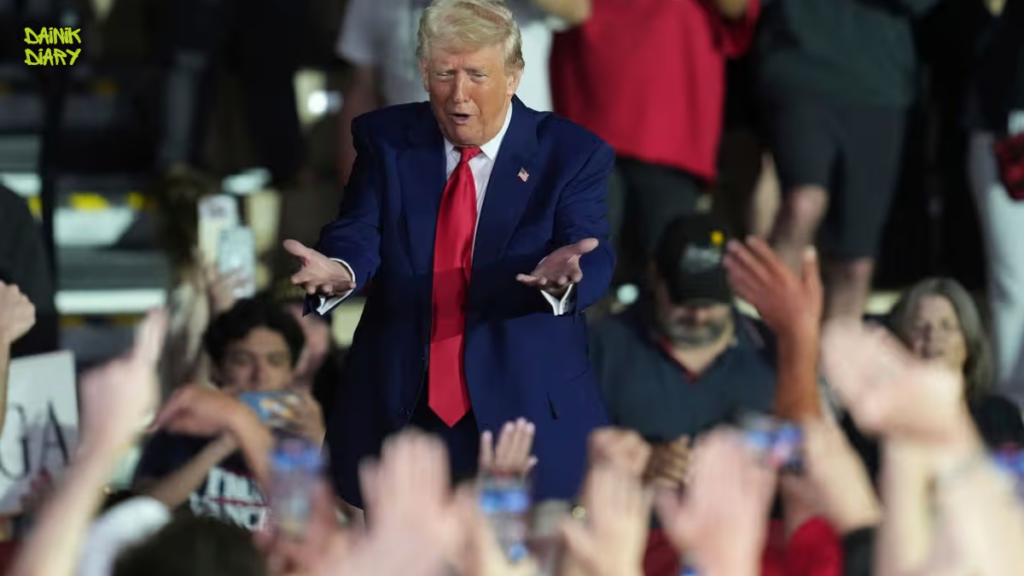
Trump himself appears keenly aware of the importance of mobilising his supporters.
At a rally in late August, the president urged voters to “pretend” that he personally was on the ballot when they vote in the congressional elections.
The message carries echoes of Trump’s approach during the 2018 midterms, when he attempted to turn congressional races into a referendum on his presidency.
This time, Republicans are again fighting to protect their position in Congress, while Democrats hope voter dissatisfaction over the economy and Iran can help them make gains.
The White House, however, strongly rejects the suggestion that Trump has failed to deliver.
White House spokeswoman Olivia Wales has defended the president’s record, pointing to areas including tax cuts, prescription drug costs, border security and economic policy as evidence that the administration has fulfilled important commitments.
The bigger question will not be answered by individual interviews or a single opinion poll.
It will come in November.
If frustrated Trump voters ultimately stay home, support Democrats or break from Republican candidates in competitive districts, the emerging doubts could have real electoral consequences. If they return to the Republican fold despite their complaints, Trump will once again demonstrate the durability of the political coalition that has defined American politics for more than a decade.
For now, the warning signs are difficult to ignore: some voters who once backed Trump enthusiastically are no longer afraid to say they are disappointed.